
Impermax Polyurea H Supreme Application: Step-by-Step Spray Guide
Impermax Polyurea H Supreme is a polyurea membrane hot-sprayed with mechanical equipment at 1:1 by volume. This Impermax Polyurea H Supreme application guide follows the installation steps set out in its datasheet: substrate preparation, mixing, spray settings, thickness, site conditions, curing times and checks.
- Product: Impermax Polyurea H Supreme
- Application: two-component hot spray
- Mix: A=1 : B=1.05 by weight / 1:1 by volume
- Spray rate: 1–2 kg/m²
If a second coat is needed, spray it straight after the first – and never wait more than 2 hours between coats.
01 · Substrate
Step 1: substrate requirements and preparation
- Flat and levelled, with an even, regular surface.
- Compact and cohesive: a pull-off test must show at least 1.4 N/mm².
- Free of cracks and fissures; repair any before spraying.
- Clean and dry: no dust, loose particles, oils, organic residues or laitance.
- Concrete: mechanical preparation by high-pressure sand blasting or scarifying to remove the surface layer and open the pores, then priming and levelling to a regular surface; grind off sharp irregularities and remove dust by brushing or vacuum. Skipping the primer can lead to premature delamination, cracking or contraction.
- Metal: sand thoroughly to a dust-free finish and use an adhesion-promoting primer (e.g. PU Primer) to prevent deformation, cracking or adhesion failure.
For the product itself – properties, approvals and uses – see Impermax Polyurea H Supreme for roofs that move.
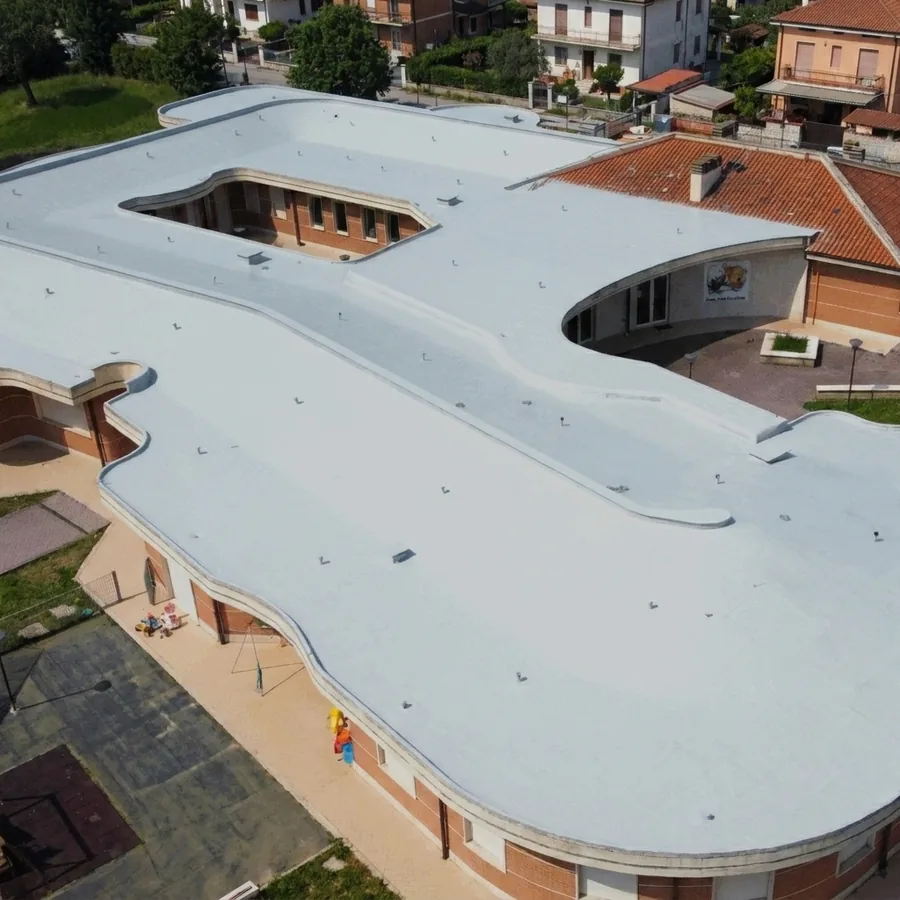
02 · Mixing & spraying
Step 2: mixing and spray settings for Impermax Polyurea H Supreme application
Stir and homogenise each component separately with suitable mixing equipment before loading the machine; the best mixers have extensible blades with an overall width of about 1/3 of the drum diameter. Add the required Pigment Spray to component A and stir before loading, then recirculate both components while heating to application temperature.
Apply only with two-component hot-spray equipment. Recommended temperatures are 70 °C for component A, 75 °C for component B and 70 °C for the hose, at 150 bar. Spray at 1–2 kg/m², checking layer thickness and curing speed as you go. Mixing faults are the usual root cause of failures – see 2K mix errors.
The required thickness is usually reached in one coat. If a second coat is needed, apply it immediately afterwards and in any case within 2 hours. When spraying over a previously applied epoxy primer, make sure it is fully cured (about 8 hours).
Technical datasheet: Impermax Polyurea H Supreme TDS (PDF) · Polyurea waterproofing systems
03 · Application figures
Impermax Polyurea H Supreme technical data (TDS values)
Spray rate
1–2 kg/m²
Spray pressure
150 bar
Component A / B temperature
70 / 75 °C
Gel time at 25 °C
12 s
Mixing and equipment
- Mix ratio: A=1, B=1.05 by weight; A=1, B=1 by volume
- Gel time (A+B, 20 g): 12 s at 25 °C; tack-free in 20 s
- Temperatures: component A 70 °C, component B 75 °C, hose 70 °C
- Pressure: 150 bar
- Spray rate: 1–2 kg/m²
- Pigment: Pigment Spray paste supplied with each kit, added to component A
- Before use: store at 10–30 °C; use within 12 months of manufacture in the sealed container
Site conditions
- Substrate temperature: 10–40 °C; above that, extra measures as advised by the manufacturer
- Substrate moisture: below 4%
- Air temperature: 10–40 °C, relative humidity below 70%
- Wind: above 25 km/h can cause excessive exotherm loss, poorer gun mixing, affected surface texture and cure, and overspray
04 · Curing & checks
Step 3: curing, return to service and site checks
Approximate hardness, for reference only (2 mm on polypropylene, 20 °C, 50% RH): 53 after 45 min, 56A after 3 hours and 65A after 1 day. Under usual conditions (25 °C, 50% RH) the membrane resists rain droplets after 5 minutes, takes light foot traffic after 1 hour, and reaches more than 90% of its final properties after 1 day.
Aromatic polyurea changes colour in sunlight without affecting its mechanical properties; extra UV protection can be achieved with an Impertrans or Colodur topcoat. Bubbles on porous substrates are covered in more depth in pinholes and blisters.
Troubleshooting checklist
- During spraying: monitor layer thickness and curing speed continuously.
- Product does not cure: check the A/B ratio; the usual cause is pressure differences – check and correct machine operation.
- Bubbles or open pores on a porous substrate: caused by missing primer – apply a suitable primer first.
- Poor hiding on a horizontal surface: if there is too little product, apply 1 kg/m²; if too little pigment, make sure component A and pigment are fully homogenised.
- Colour change in sunlight: a UV reaction – use a final coat in dark grey or red.
- Application without pigment: not advised; the product is always supplied with the chosen pigment, which helps give a uniform appearance.
05 · FAQ
Impermax Polyurea H Supreme: frequently asked questions
What spray settings does Impermax Polyurea H Supreme need?
Component A at 70 °C, component B at 75 °C, hose at 70 °C and 150 bar, sprayed at 1–2 kg/m².
How long can I wait between coats?
Spray the second coat straight after the first; never wait more than 2 hours.
When can the membrane take foot traffic?
At 25 °C and 50% RH it resists rain after 5 minutes and light foot traffic after 1 hour.
More Impermax and Rayston polyurea products
Every product page in this series is based on its official Krypton Chemical technical datasheet.
Links
Next steps
Distributors
Get in touch about the supply and application of Impermax Polyurea H Supreme.
Knowledge
Contact
For technical enquiries, please use the Distributors button above.