
Polyurea H SL: Slow-Reacting Polyurea Flooring Resin for Hot Spray
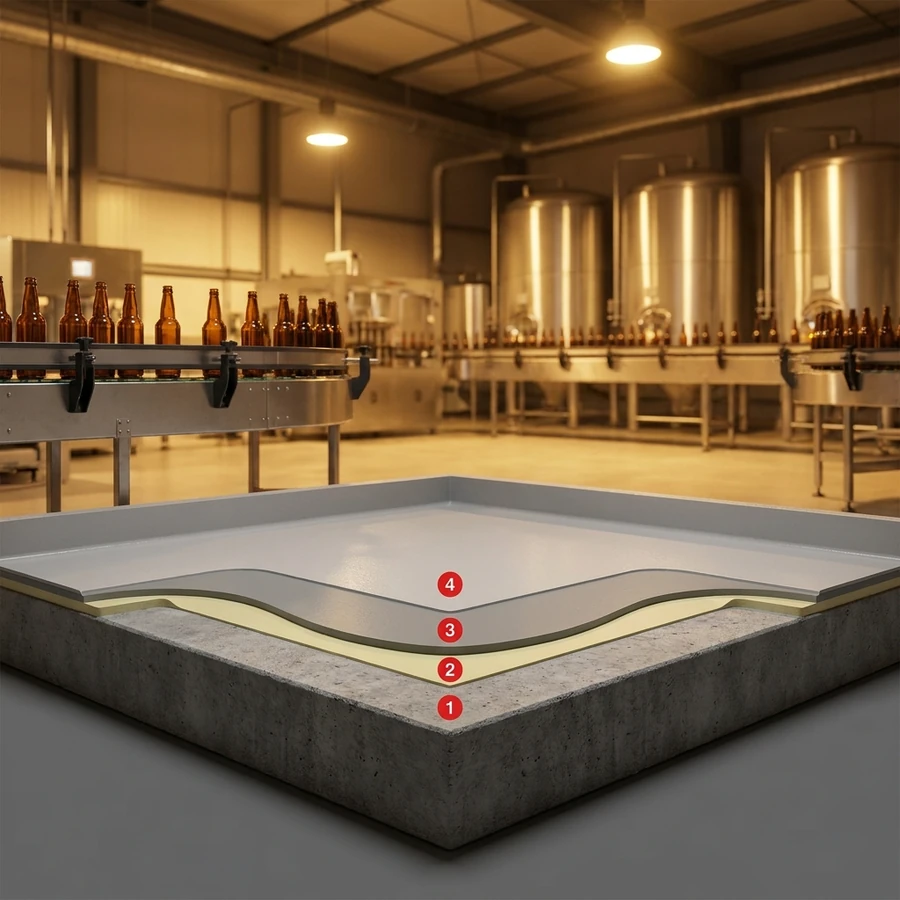
Polyurea H SL is a two-component, slow-reacting polyurea flooring resin, hot-sprayed to create seamless floor membranes, with or without broadcast aggregate.
- Product: Polyurea H SL
- Application: hot-spray flooring
- Mix: A=1 : B=1.12 by weight / 1:1 by volume
- Gel time: 1.5 min at 25 °C
- Colours: light grey, dark grey, rust red, blue
Always supplied with the chosen pigment, which helps achieve a uniform appearance; application without pigment is not recommended.
01 · Uses
Uses of a slow-reacting polyurea flooring resin
- General fast-track flooring systems.
- Decorative and industrial floors that need quick execution.
- Seamless floor membranes, with or without broadcast aggregate.
Choosing a floor system? See resin floor classes by traffic and the industrial flooring application page.
02 · Application
Application of Polyurea H SL
Polyurea H SL is applied with hot plural-component spray equipment. Concrete is prepared mechanically by shot blasting, scarifying or diamond grinding to open the pores, then primed and repaired to a regular surface; sharp irregularities are ground off and dust removed by vacuum.
The substrate must be flat and cohesive, with a pull-off strength of at least 1.4 N/mm², free of cracks, clean and dry. Add the pigment to component A and stir at low speed for a few minutes – overmixing increases moisture uptake.
To broadcast sand or aggregate on the top coat, wait until viscosity rises (about 1 min); the surface stays receptive for 4–10 minutes after spraying. The required thickness is usually reached in one coat.
Technical datasheet: Polyurea H SL TDS (PDF) · Polyurea waterproofing systems
03 · Technical data
Polyurea H SL technical data (TDS values)
Shore hardness
95A/55D
Elongation at break
160%
Tensile strength
13 MPa
Tear strength
78 N/mm
Technical data
- Hardness (Shore): 95A/55D (ISO 868)
- Elongation at break: 160%
- Tensile strength: 13 MPa (EN-ISO 527-3)
- Tear strength: 78 N/mm (ISO 34-1, method B)
- Adhesion: 5.6 MPa on concrete (EP 100 primer); 3.6 MPa on steel (PU primer)
- Abrasion: 40 mg (Taber, CS10, 1 kg, 1000 cycles)
- Chemical resistance (24 h surface contact at room temperature; 5 best, 0 worst): water 5; sodium hydroxide 20%, 33% and 50%: 5; glycerine (50% in water) 5; sulphuric acid 10%: 5; ammonia 3%: 4; isopropyl alcohol 3; xylene 0
04 · Performance
Polyurea H SL performance
It cures to a hard membrane of 95A/55D, with Taber abrasion of 40 mg (CS10, 1 kg, 1000 cycles). As an aromatic polyurea it changes colour in sunlight; additional UV protection comes from a fast-curing aliphatic topcoat.
With quartz sand broadcast, it is walkable 2–4 hours after application; under usual conditions (25 °C, 50% RH) the broadcast membrane takes light foot traffic after 2 hours.
Application data
- Mix ratio: A=1, B=1.12 by weight; A=1, B=1 by volume
- Gel time (A+B, 20 g): 1.5 min at 25 °C, 1 min at 60 °C
- Recommended temperatures: component A 60 °C, component B 60 °C, hose 59 °C
- Pressure: 140–150 bar
- Spray rate: 2–3 kg/m² (reference)
- Broadcasting: after about 1 min; surface open for 4–10 min after spraying
- Air temperature: 10–40 °C, relative humidity below 85%
- Storage: 10–30 °C, dry; use within 12 months of manufacture in the sealed container
05 · FAQ
Polyurea H SL: frequently asked questions
Why a slow-reacting polyurea for floors?
A 1.5-minute gel time at 25 °C lets the resin level out and leaves a 4–10 minute window to broadcast sand or aggregate.
Can Polyurea H SL be used without pigment?
It is not recommended; it is always supplied with the chosen pigment to give a uniform appearance.
When can people walk on it?
With quartz sand broadcast, after 2–4 hours; at 25 °C and 50% RH light foot traffic is possible after 2 hours.
More Impermax and Rayston polyurea products
Every product page in this series is based on its official Krypton Chemical technical datasheet.
Links
Next steps
Distributors
Get in touch about the supply and application of Polyurea H SL.
Knowledge
Contact
For technical enquiries, please use the Distributors button above.