Merryland Lake Waterproofing, Heliopolis
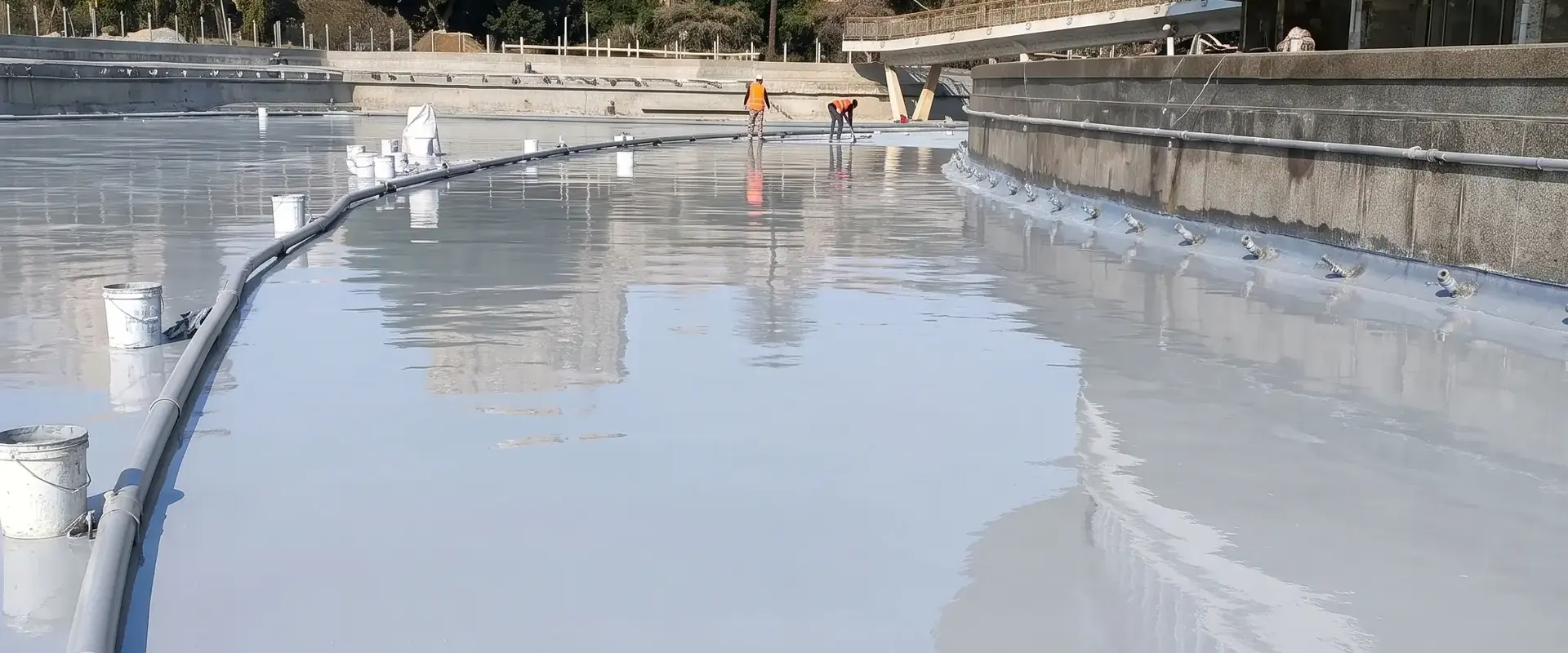
In 2019 the lake at Merryland Park in Heliopolis was lined with hot-sprayed pure polyurea. The basin sits in a public garden, against a curved building, and it has to hold water through a Cairo summer.
Overview
Merryland is one of the old public gardens of Heliopolis. People walk the edge of this water. A leak does not stay a technical note. It drops the level, stains the promenade, and puts the garden out of use while someone hunts for a lap that opened.
Krypton Chemical made the resin. The crew on site sprayed it. The duty was a lining that is one film from the floor, up the curved wall, and around every outlet.
| Place | Merryland Park, Heliopolis, Cairo |
|---|---|
| Year | 2019 |
| Structure | Concrete lake basin beside a curved building |
| Membrane | Polyurea Rayston, hot-spray pure polyurea |
Challenge
A park lake is not a roof that dries between storms. Water stands on the film every day. Any path through the lining becomes a path under the basin, and the first sign is a wet patch in a planter or a slow loss of level that nobody can point to.
The geometry is the hard part. The floor meets a tall concrete wall on a curve. Pipes and outlets pierce that wall. Those are the lines that move differently from the field: the wall heats in the Heliopolis sun, the water stays cooler, and the corner between them works every afternoon. A membrane that is brave in the middle and thin at the outlet will fail at the outlet.
The basin is also open to the garden. Dust, leaves, and foot traffic during the works all want a wet film. The lining has to lock quickly, then stay elastic for the life of the concrete under it.
Solution
The membrane is Polyurea Rayston, Krypton Chemical’s hot-spray pure polyurea. It is made for ponds, canals, and water-holding concrete, sprayed as two components through a heated machine. Gel time is about 4 seconds at 25 degrees C, and the film is tack-free in about 30 seconds once the components are at spraying temperature. On an open lake that is the difference between a clean lining and a lining full of garden dust.
The typical build is 1.5 to 2.0 kg per square metre, which gives about 1.5 to 2 mm. Elongation is about 324 percent and tensile strength about 16.2 MPa, with tear strength of 69 N/mm. Those numbers are the product’s own data. They are why a curved wall joint can move without tearing the film, and why a maintenance crew can walk the empty basin later without cutting it. Liquid water permeability is 0.002 kg per square metre per square-root hour. For a lake, that is the property that earns the specification.
The colour on this basin is a light grey, one of the standard shades. Polyurea Rayston is aromatic, so sunlight can shift the shade over time. That shift does not take the strength with it. Where the owner wants the grey held, an aliphatic topcoat does that job. The lake lining itself is the polyurea.
Application
The concrete has to earn the bond before anyone heats the machine. Pull-off should be at least 1.4 N/mm2. Moisture in the substrate stays under 4 percent. Surface temperature sits between 10 and 40 degrees C, and the air humidity for a clean bond stays under 85 percent. Higher moisture does not stop the polyurea from reacting. It does make the bond harder to trust.
Preparation is mechanical. Open the pore by grinding or blasting, repair cracks before the spray, knock off sharp edges, and vacuum the dust. A lake that has already held water needs that step more than a new roof: the surface can look sound and still carry laitance and old biofilm. If damp is suspected from below, the datasheet calls for two coats of epoxy primer, the second one blinded with quartz. Metal pipes are cleaned and primed with the polyurethane primer.
Both components are brought to about 25 to 30 degrees C before they go in the machine. The amine side is stirred and pigmented. Then the spray: component A at 65 degrees C, component B at 75 degrees C, hose at 65 degrees C, pressure at least 140 bar. The pass is watched for thickness, because 1.5 to 2 mm is a build you can miss in a corner if the gun hurries.
The floor is the easy pass. The curved wall, the cove, and each outlet are the pass that decides the lake. The same film has to arrive there, at the same thickness, tied into the pipe flange so water cannot track behind the lining. Gel in four seconds means the detail is sprayed and left. It is not brushed out later.
Hardness builds from the first minutes. The datasheet tracks Shore A from five minutes through four days at 25 degrees C. The basin should not be put back in service until the details have been walked and the outlets accepted. A flood of the empty lining, before the garden is reopened, tells you more than a gauge in the middle of the floor.
Results
The lining is a continuous pure polyurea film over the floor and up the wall, light grey, with the outlet line on the curved side taken into the same membrane. That is the result this lake needed: no lap for the water to work on, and enough elongation for the daily temperature swing in Heliopolis.
Crack bridging on the datasheet reaches class A5 at minus 10 degrees C and class B4.2 at both 23 and minus 20 degrees C. Cairo will not ask for the cold end of that range. It will ask for the movement. Shore hardness of 87A and 35D is the other half: soft enough to follow the concrete, firm enough that a drained basin can be cleaned.
Products
Polyurea Rayston
Hot-spray pure polyurea. Typical rate 1.5 to 2.0 kg per square metre for 1.5 to 2 mm. Elongation about 324 percent, tensile strength about 16.2 MPa, tear 69 N/mm, Shore 87A / 35D. Gel about 4 seconds at 25 degrees C.
FAQ
How fast does the polyurea gel on an open lake?
Polyurea Rayston gels in about 4 seconds at 25 degrees C. On an open basin in Heliopolis that speed matters: dust and a sudden breeze do not get a long wet film to land in.
How thick is the lining?
The typical spray rate is 1.5 to 2.0 kg per square metre, which builds a film of about 1.5 to 2 mm. That figure is product data, not a core taken from this lake.
Can the floor-to-wall joint move?
The membrane elongates about 324 percent and bridges cracks in the classes given on the datasheet. A park lake moves every day between sun on the concrete and cool water.
Will the grey colour stay in the sun?
Polyurea Rayston is aromatic. Sunlight can shift the colour. The mechanical film does not depend on that colour. An aliphatic topcoat is how the shade is held when the basin stays open to the sky.
What does the concrete need before spraying?
Pull-off at least 1.4 N/mm2, moisture under 4 percent, and a surface between 10 and 40 degrees C. The pore has to be open, and the dust from grinding has to be gone.
Photos