Cairo Festival City Waterproofing, New Cairo
Cairo Festival City, in New Cairo, has been waterproofed in more than one campaign: hot-spray polyurea on roofs in 2018, sprayed foam on roofs in 2020, polyurea on the structural joints in 2021, and a continuous membrane on the podium decks.
Overview
Cairo Festival City is a working district of New Cairo: retail, offices, and plazas that people cross every day. Waterproofing here is not a hidden roof only. Water that gets through a podium ends up in a ceiling over shops, a car park, or a plant room.
The work came in stages, because the buildings did. Roofs took hot-spray pure polyurea in 2018. In 2020, 3,000 square metres of roof were insulated with sprayed polyurethane foam. In 2021 the structural joints were sealed with polyurea. The podium decks in front of the glass buildings were given their own continuous membrane, carried into the linear drains and up the wall.
| Place | Cairo Festival City, New Cairo |
|---|---|
| 2018 | Hot-spray pure polyurea on roofs |
| 2020 | Sprayed polyurethane foam on roofs, 3,000 square metres |
| 2021 | Polyurea on structural joints |
| Decks | Continuous membrane on the podium, into the drains |
Challenge
New Cairo gives a roof a hard day. The sun is high, the nights cool fast, and a wide concrete deck moves. A roof membrane that is stiff at dawn and soft at noon will crack at the upstand, which is exactly where the water is heading.
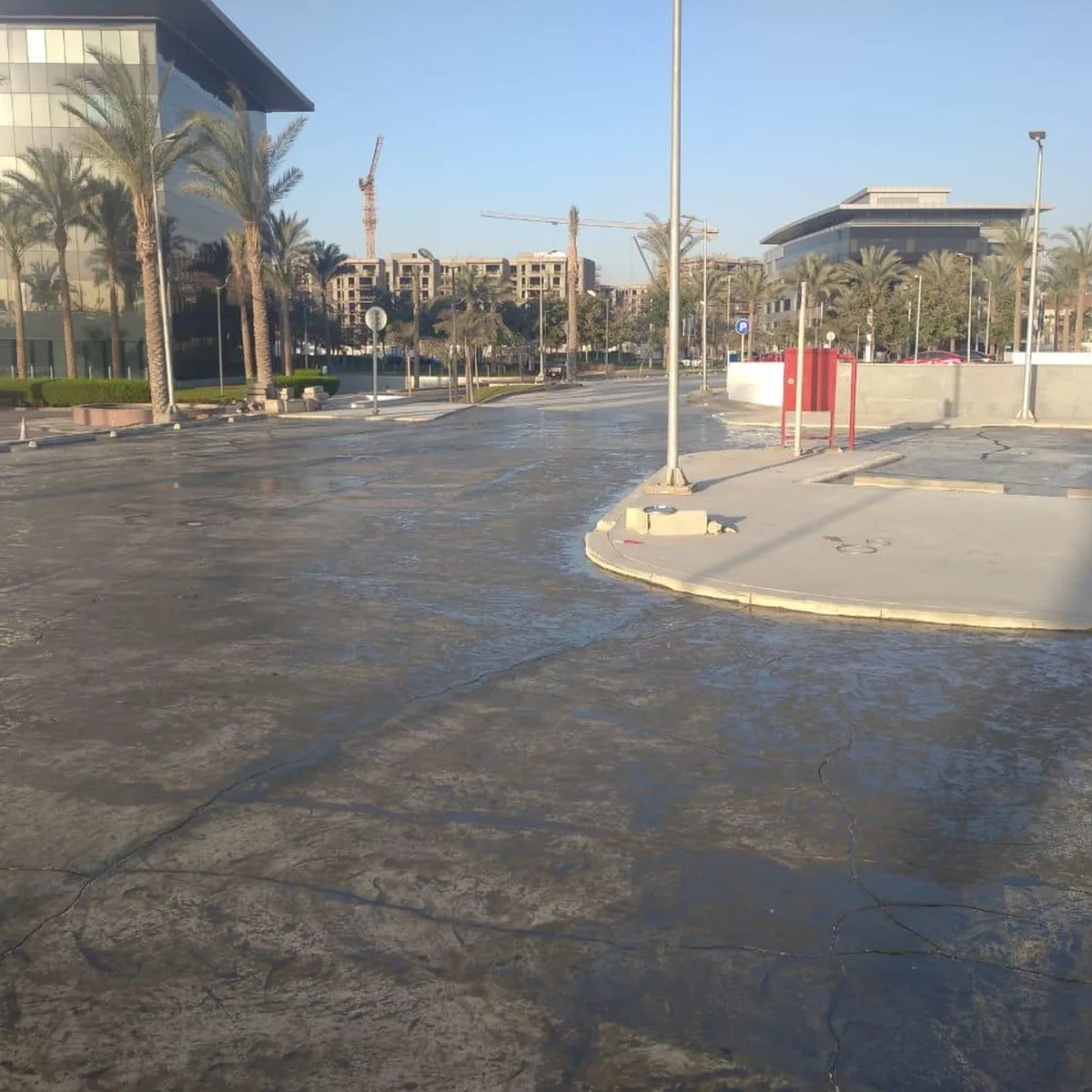
The podium is a different animal. It is a plaza, not a sheltered roof. Cars, feet, and cleaning water use it. Before the membrane, the concrete was already cracked and holding water in those cracks. A crack full of water under a finished plaza is a leak into the space below, and it will show up far from the crack that fed it.
Joints are the third duty. A structural joint is designed to move. If it is bridged with a short, brittle bead, the first summer opens it. The field of the roof can be sound and the joint can still be the leak.
Solution
For the roofs and the joints, the membrane is Polyurea Rayston, hot-sprayed pure polyurea from Krypton Chemical. It gels in about 4 seconds at 25 degrees C, so a joint can be filled and left. Typical thickness is 1.5 to 2 mm from 1.5 to 2.0 kg per square metre. Elongation of about 324 percent is what a moving joint and a sun-loaded roof both ask for. Tensile strength is about 16.2 MPa and tear strength 69 N/mm.
The 2020 foam is insulation, not the waterproof layer. Sprayed polyurethane foam on 3,000 square metres of roof cuts the heat load on the space below. Foam left bare will take water. It needs the membrane over it, detailed at outlets and parapets the same way as the field.
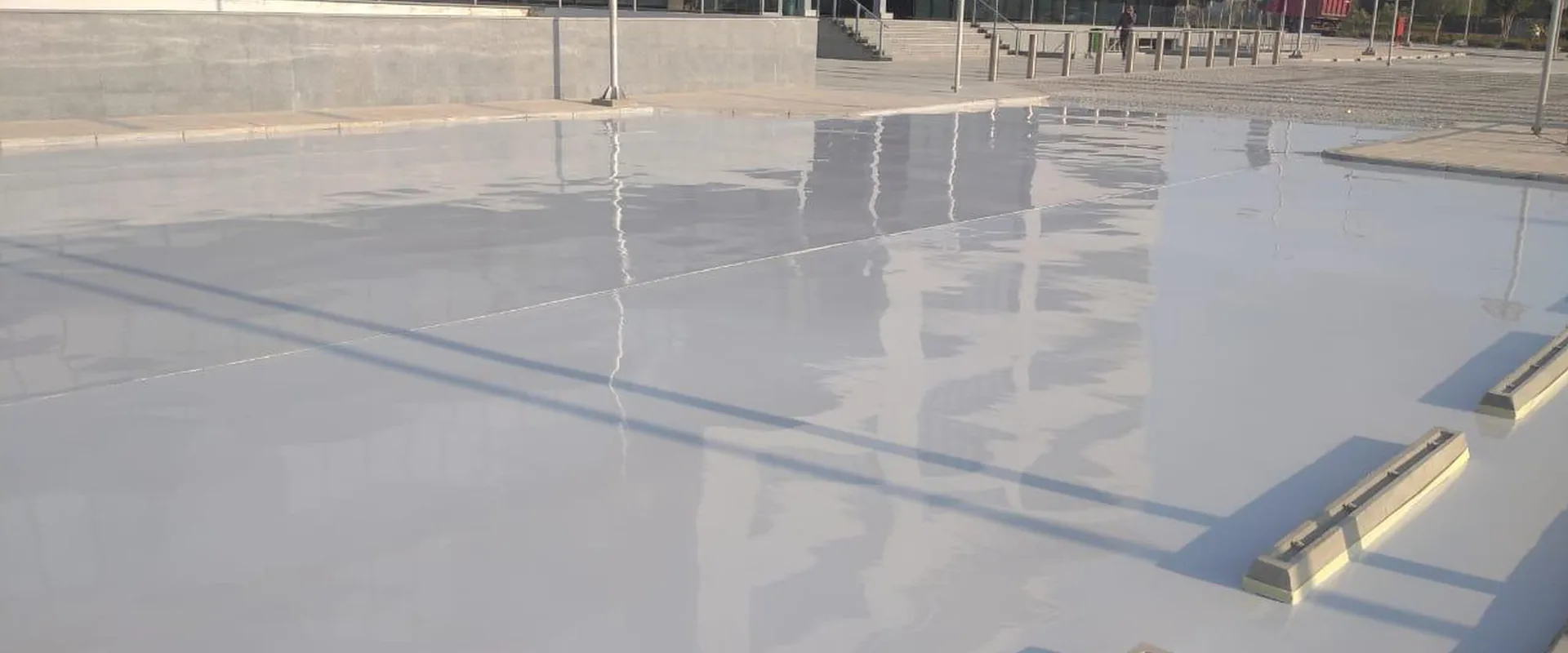
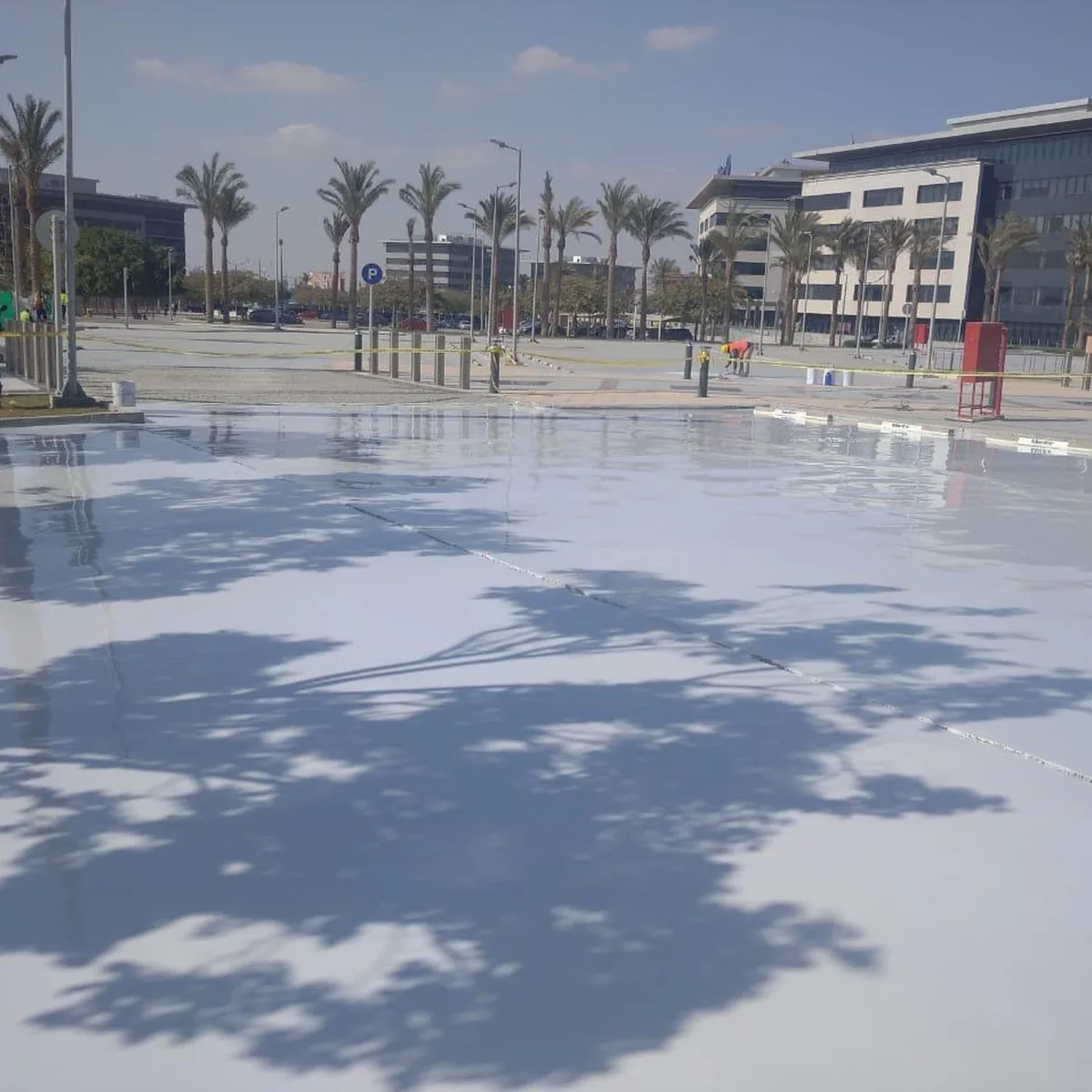
On the podium the concrete received a continuous light-grey waterproofing membrane across the bays, finished into the slot drains and turned up at the wall under the glass. That deck is walked and driven. The film has to survive that, and it has to be one piece, because a joint in the membrane over a crack in the concrete is two leaks sharing an address.
Application
Polyurea Rayston is not a roller product. It needs a two-component hot spray machine. Concrete is opened mechanically until the pore is clean, cracks are repaired first, and dust is vacuumed. Pull-off should reach at least 1.4 N/mm2. Moisture stays under 4 percent. The surface temperature stays between 10 and 40 degrees C.
Components are preconditioned around 25 to 30 degrees C. Spray temperatures are 65 degrees C on the amine, 75 degrees C on the isocyanate, and 65 degrees C in the hose, at a pressure of at least 140 bar. The gun keeps moving so the 1.5 to 2 mm builds evenly. On a roof, the outlet, the parapet, and the skylight curb get the same pass as the field. On a joint, the polyurea has to fill the movement gap and grip both edges. A skim across the top of a joint is not a seal.
The podium starts from a wetter truth. Water was sitting in the cracks. That deck has to be dried, the cracks treated, and the surface opened before any film goes down. The membrane then runs through the drain line, not up to it, and it rises at the wall so splash at the facade cannot get behind it. A flood on the bare concrete is how you find the low points. A flood on the finished film is how you accept them.
Foam, where it was used in 2020, is sprayed as the insulation layer and then protected. It is not left as the weathering face. Outlets are cut and detailed after the foam, not buried under it.
Results
The roofs have a hot-spray polyurea membrane from 2018, with the elongation and the crack-bridging classes of Polyurea Rayston behind them. The 2020 roofs carry 3,000 square metres of sprayed foam as insulation. The 2021 joints are sealed in polyurea so movement stays in the joint and out of the field.
The podium is a continuous light-grey membrane over bays that used to hold water in the cracks, tied into the linear drains and the wall. That is the detail a plaza over occupied space has to get right. Sunlight can shift the colour of aromatic polyurea on an exposed roof. The film’s strength does not follow the colour. An aliphatic topcoat is there when the appearance has to stay put.
Products
Polyurea Rayston
Hot-spray pure polyurea for the 2018 roofs and the 2021 joints. Typical 1.5 to 2 mm. Elongation about 324 percent. Gel about 4 seconds at 25 degrees C.
Spray polyurethane foam
Roof insulation in 2020, 3,000 square metres. The foam is the thermal layer. Waterproofing over it is a membrane, detailed at every outlet.
FAQ
Why does a podium crack matter here?
Water sat in the cracks of the plaza concrete. A crack under a paved deck becomes a path into the space below. The membrane has to cross the bay as one film and finish into the drain, not stop on the flat.
What went on the roofs in 2018?
Hot-spray pure polyurea. Polyurea Rayston is sprayed at 65 degrees C on the amine side, 75 degrees C on the isocyanate side, and at least 140 bar, at 1.5 to 2.0 kg per square metre.
What was the foam work in 2020?
Sprayed polyurethane foam on the roofs, 3,000 square metres. Foam is the insulation. It is not the waterproof film. The waterproofing is a separate membrane.
Why seal the joints in 2021 as their own job?
A structural joint moves more than the field of a roof. Polyurea Rayston bridges that movement. Typical elongation is 324 percent, and the gel is about 4 seconds at 25 degrees C, so the joint is filled before the edges skin over.
Does sunlight damage the aromatic polyurea?
The colour can shift. The strength does not. Where the roof stays exposed, an aliphatic topcoat holds the appearance. The datasheet is clear on that split.
Photos