How to Waterproof Industrial Plant Roofs with Polyurea
To waterproof industrial plant roofs with polyurea is to seal a crowded equipment deck as one film, then prove it with a water test before the plant relies on it. At Khalda Petroleum’s Qasr facilities, the roof was prepared, primed, sprayed with polyurea and water-tested in 2021, as part of the Khalda Petroleum waterproofing works.
01 ·
What is this work?
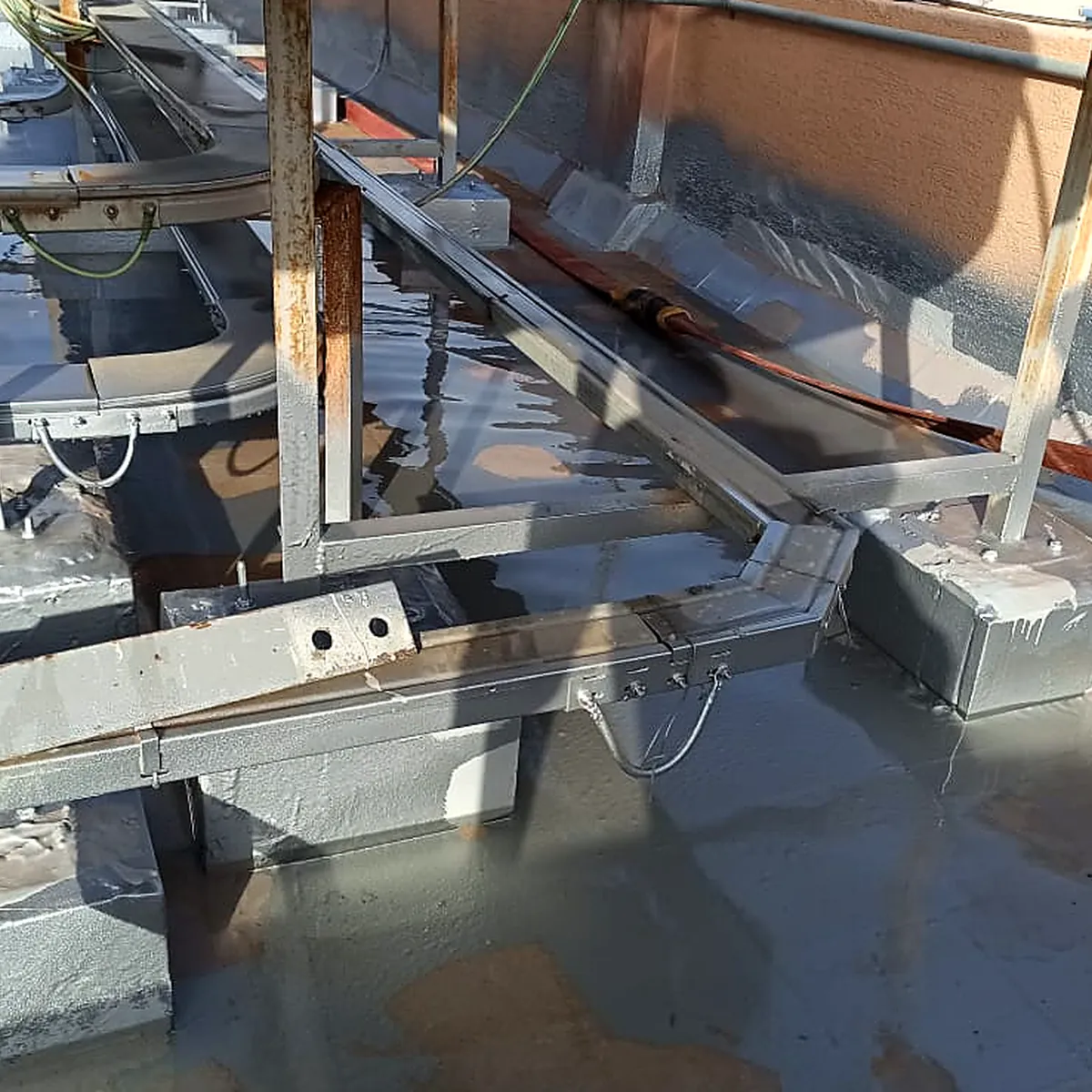
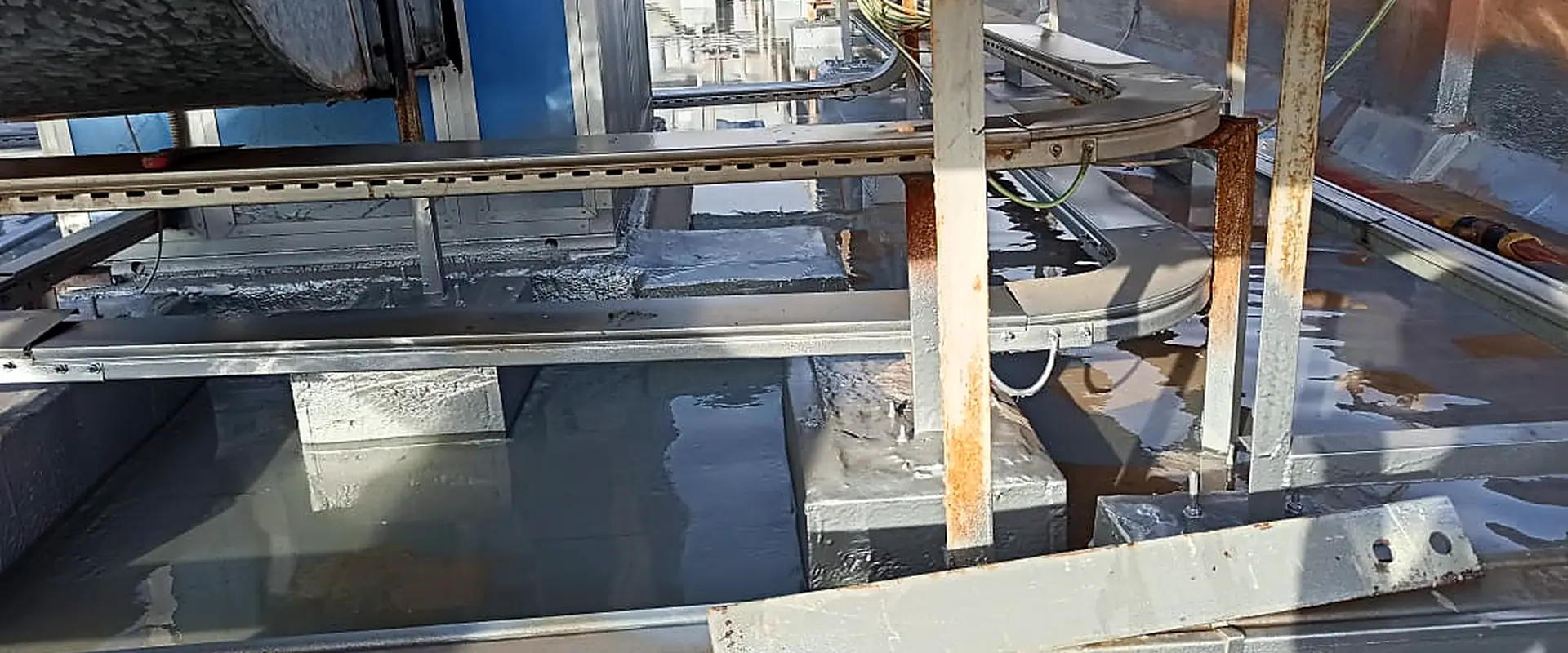
An industrial plant roof is not an empty slab. Air-handling units, cable trays, pipe racks and steel frames sit on it. Water that gets under a unit base or along a tray support can travel a long way before anyone sees a stain. The lining has to be formed around that equipment, not drawn as a clean rectangle on a drawing.
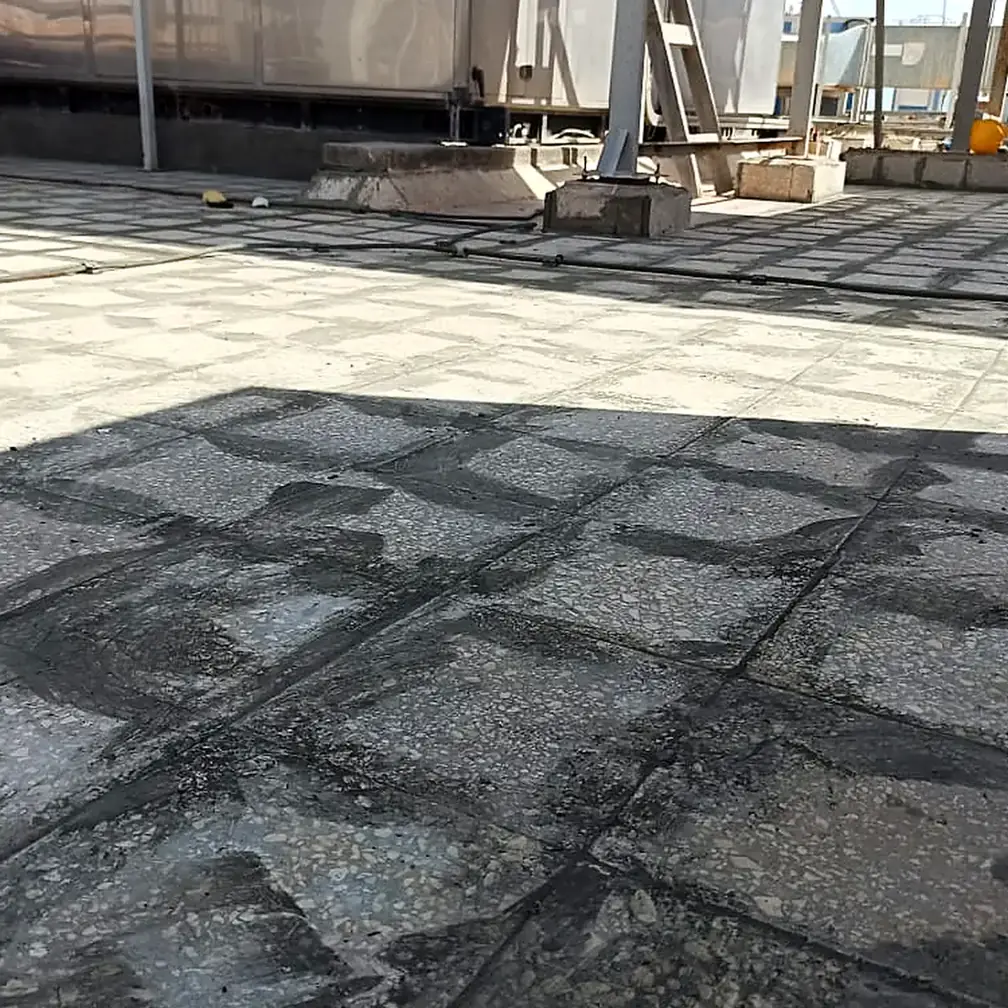
In 2021, plant roofs in the Khalda Petroleum concession, including the Qasr facilities, were prepared, primed and sprayed with polyurea, then water-tested. The work belongs to the same Khalda Petroleum waterproofing programme at Abu Gharadig as the tiled-roof spray and the evaporation-pond lining. The application was carried out by ETS, the engineering contractor for those Khalda sites, using Krypton Chemical systems from Spain.
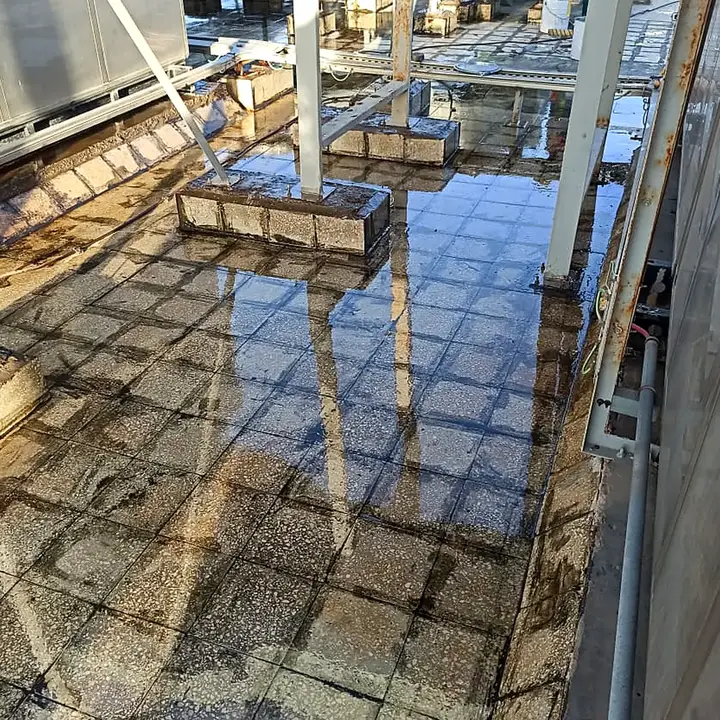
A water test on a plant deck is the honest end of the job. If the details around the equipment are tight, the water stays on the membrane. If they are not, you find out before the roof goes back into service.
| Place | Khalda Petroleum, Qasr facilities, Western Desert, Egypt |
|---|---|
| Client | Khalda Petroleum |
| Year | 2021 |
| System | Hot-spray Polyurea Rayston, with primer and a water test on the plant deck |
| Applicator | ETS |
02 ·
What does a plant roof demand?
The difficulty is the congestion. Steel posts land on the deck. Trays cross it. Units sit on plinths. Each landing is a corner, an upstand or a shadow the spray gun has to reach. Leave a thin edge at a base and that is where the water test will fail.
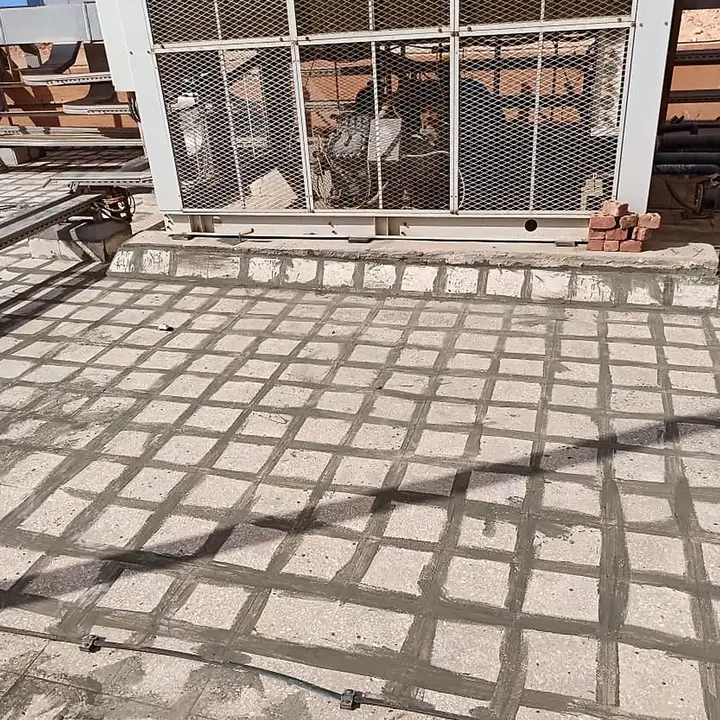
The desert adds movement and dust. The membrane has to bond, stay elastic and take a head of test water without opening at a detail. And the plant cannot wait for a slow-cure coating to wander through a week of traffic restrictions if a faster system can do the same work to a known standard.
03 ·
Which system belongs on a plant roof?
Polyurea Rayston is a hot-spray pure polyurea, 100 percent solids, applied with a two-component heated machine. It forms a continuous elastomeric membrane that can be taken up plinths and around supports as one film. Typical elongation is 324 percent, tensile strength 16.2 MPa, tear strength about 69 N/mm, and dynamic crack bridging Class B4.2 at 23 degrees C and at -20 degrees C.
Speed is part of the reason it belongs here. Gel time is about four seconds at 25 degrees C. The deck can take light contact in hours, while full hardness still builds over days. That is enough time to spray, let the film gain strength, and put a water test on the same roof without a long shutdown.
The product is assessed to EN 1504-2, with European Technical Assessment 16/0148. It is aromatic, so an aliphatic topcoat such as Impertrans or Colodur is the usual way to hold colour in the sun. Those are typical product data, not measurements taken on this roof.
04 ·
How do you waterproof industrial plant roofs with polyurea?
Preparation is most of the job on a crowded deck. Loose material comes off. The surface is opened by mechanical abrasion. Dust is vacuumed. The technical data sheet asks for a cohesive support, pull-off strength of at least 1.4 N/mm², moisture under 4 percent, and air and deck temperatures between 10 and 40 degrees C, with relative humidity under 85 percent. A primer goes down on the prepared concrete. If underlying moisture is suspected, two coats of epoxy primer, the second blinded with quartz, are the usual recommendation. Metal is cleaned and primed with a polyurethane primer.
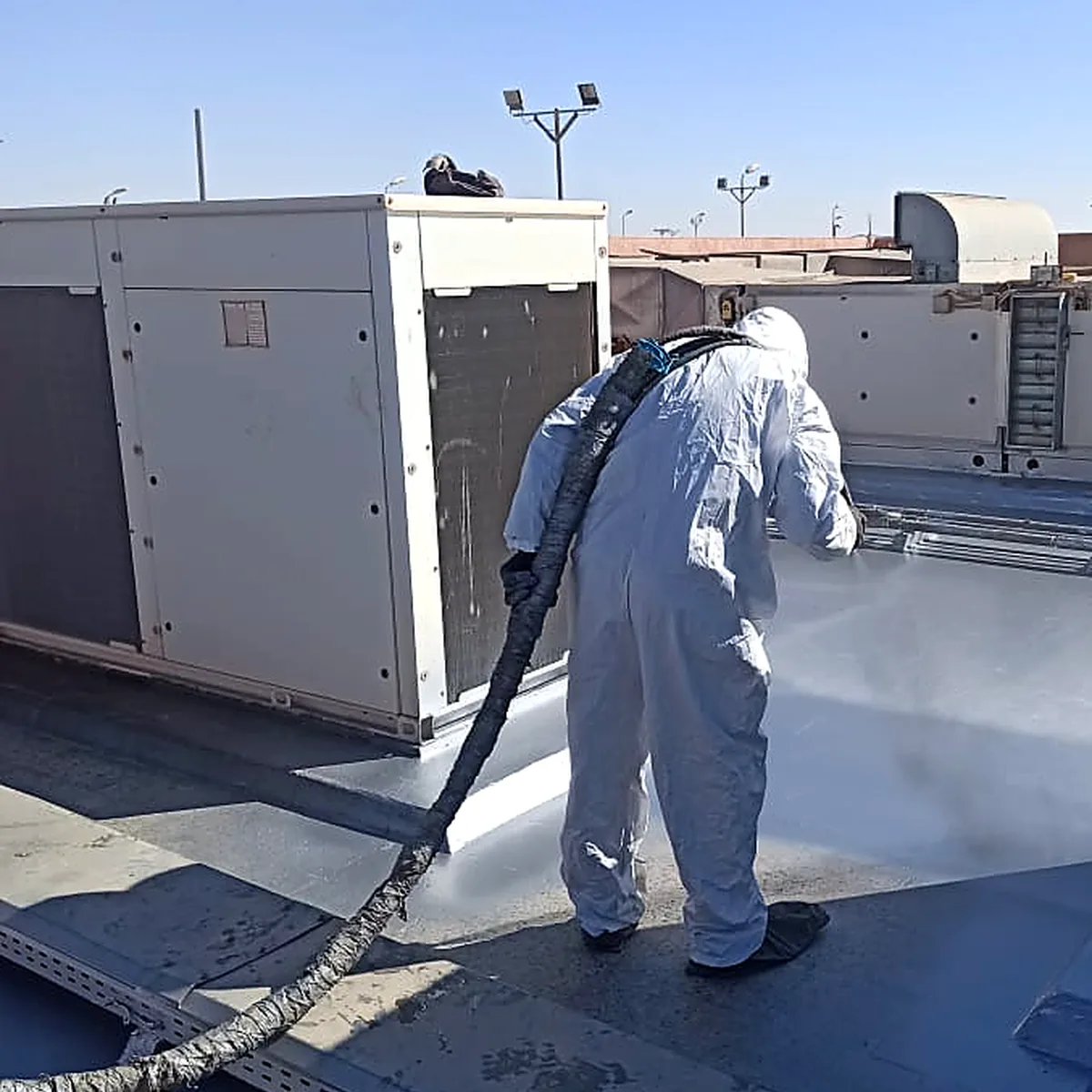
Spray conditions follow the data sheet: components preconditioned at about 25 to 30 degrees C, then about 65 degrees C on A, 75 degrees C on B, 65 degrees C in the hose, and at least 140 bar at the gun. The usual build is 1.5 to 2.0 kg/m², about 1.5 to 2 mm, in one pass. Equipment bases, upstands and tray supports are sprayed into the film. A second pass, if a corner needs it, should follow within the recoat window.
After the film has gained strength, the deck is water-tested. Water is held on the membrane and around the details. A tight roof holds it. A weak detail shows itself while the team is still on site, which is the whole point of the test.
05 ·
What does a water-tested roof deliver?
The plant keeps its equipment on a deck that has already been asked to hold water. That is a stronger statement than a visual inspection alone. The polyurea film is continuous around the units, and the test is the check that those details were sprayed thick enough and far enough up each upstand.
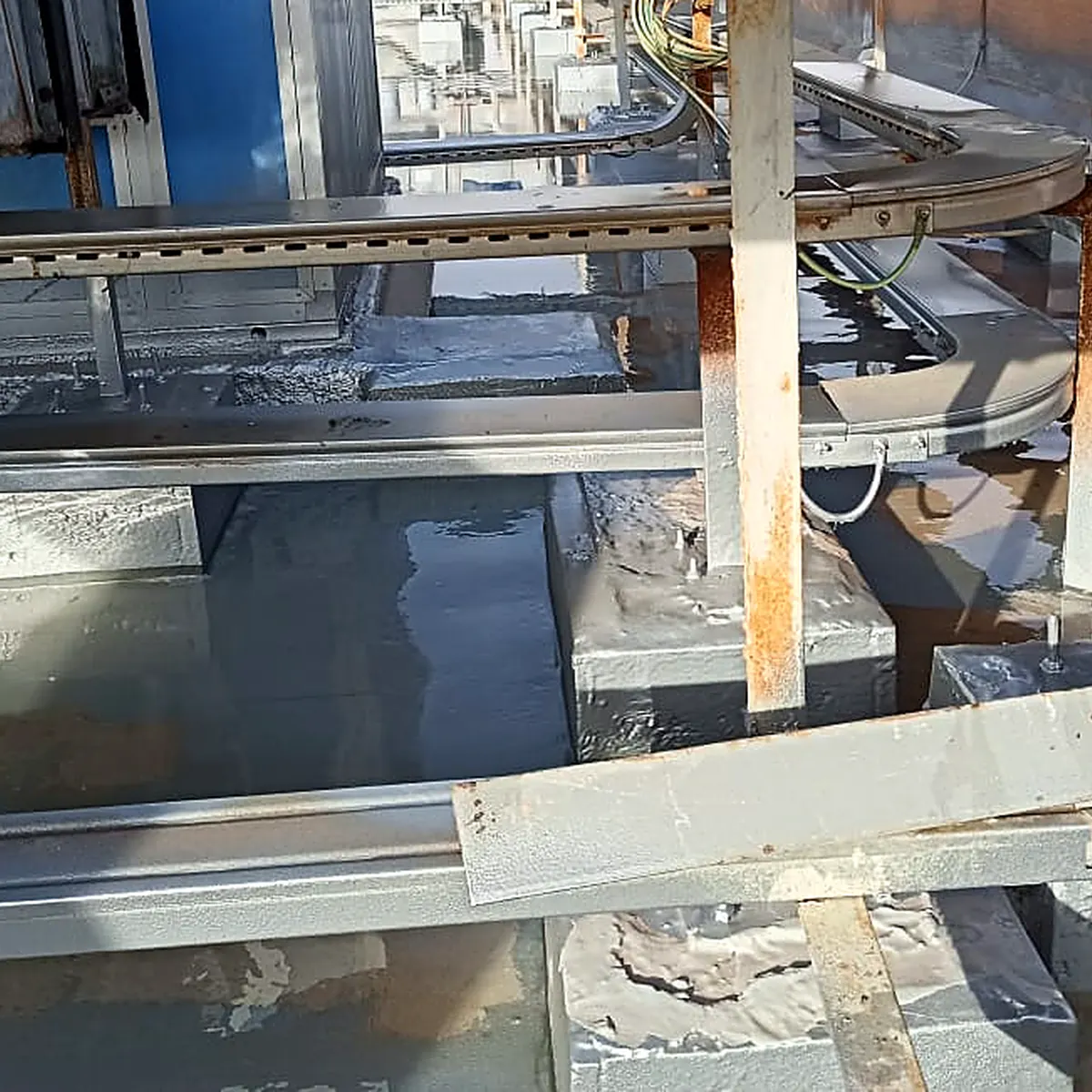
The Qasr plant roofs sit in the same Khalda programme as the tiled-roof spray and the evaporation-pond lining described on the Abu Gharadig project article.
06 ·
Which products are used?
Polyurea Rayston
Hot-spray pure polyurea for industrial roofs and plant decks. Typical build 1.5 to 2 mm. Fast gel, high elongation, ETA 16/0148. Primer as required by the support; aliphatic topcoat where UV colour matters.
07 · FAQ
Frequently asked questions
Why water-test a plant roof?
A crowded deck has many penetrations. A water test, once the polyurea has the hardness the work needs, shows whether those details are tight before the roof goes back into service.
How fast can the roof take a water test?
Polyurea Rayston is tack-free in seconds and typically reaches about 70 Shore A in an hour and about 80 Shore A in a day, with around 88 Shore A after four days. The test should wait until the film has the strength the job needs. Those are typical data-sheet figures.
How is the deck prepared?
The support must be sound, clean and dry. Mechanical preparation opens the surface. Dust is removed. A primer is part of the system. The data sheet asks for pull-off strength of at least 1.4 N/mm² and support moisture under 4 percent.
How thick is the spray?
The usual rate is 1.5 to 2.0 kg per square metre, about 1.5 to 2 mm, in one pass where possible. Upstands and equipment bases are sprayed into the same film.
Does the film need UV protection?
Polyurea Rayston is aromatic. Colour can shift in the sun; strength remains. An aliphatic topcoat such as Impertrans or Colodur is used where the finished colour matters.
Who carried out the Qasr roof work?
The application was carried out by ETS, the Engineering Co. for Trade and Supplies.
08 ·
Where is the field case?
The field case is the Qasr facilities of Khalda Petroleum, in Egypt’s Western Desert, within the same concession programme as the Abu Gharadig works. The map marks the Abu Gharadig area pin used on the project article.
Khalda Petroleum concession, Western Desert, Egypt
Photos
Photos from the Qasr plant roofs