How to Waterproof Evaporation Ponds with Polyurea
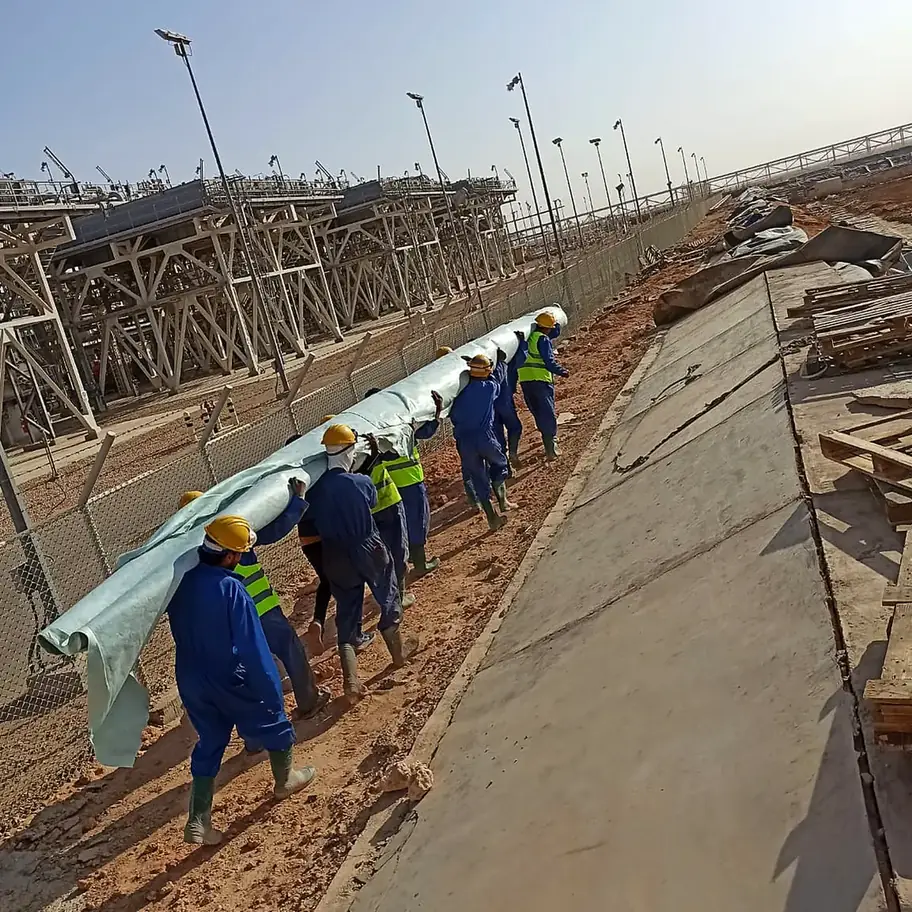
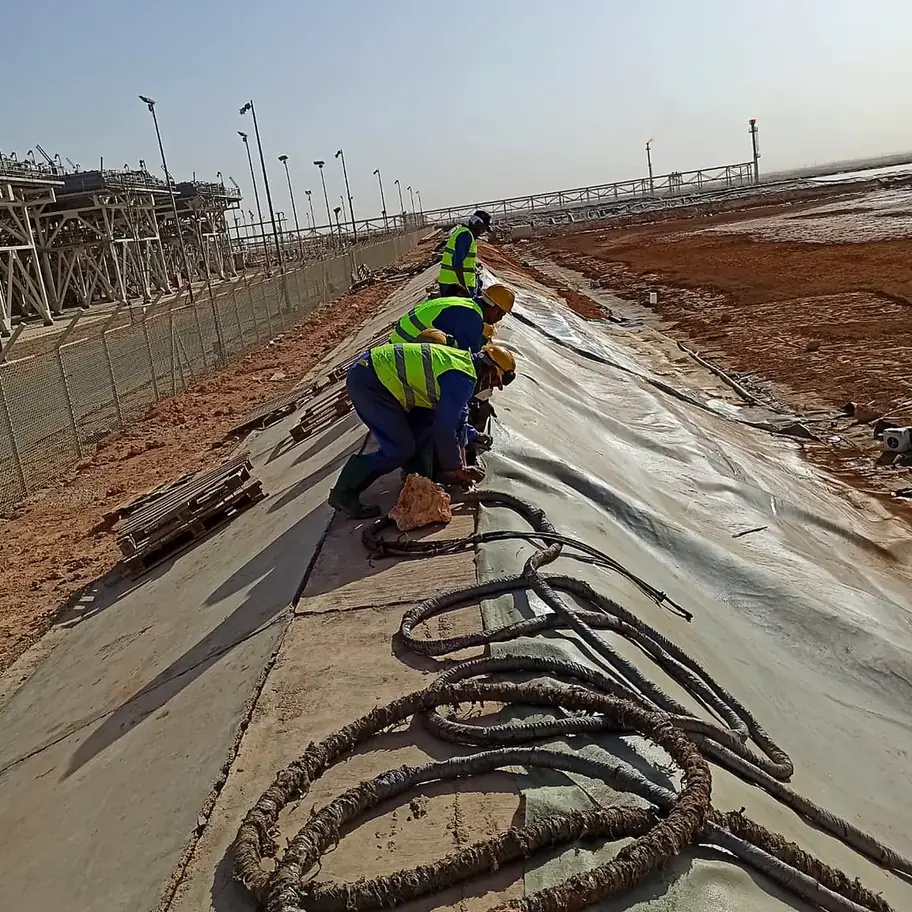
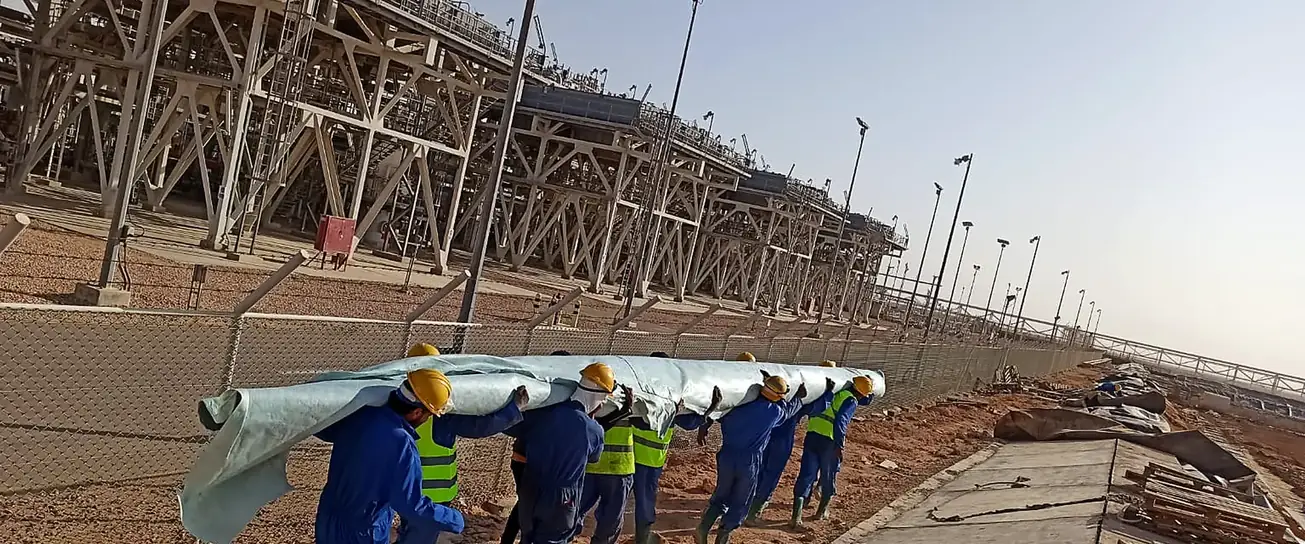
The practical way to waterproof evaporation ponds with polyurea is to line the basin as a continuous membrane, close every berm and outlet, and only then let the water in. At Khalda Petroleum in Abu Gharadig, an 8,000 m² evaporation pond was lined in 2021 with prefabricated polyurea sheets, as part of the wider Khalda Petroleum waterproofing works at Abu Gharadig.
01 ·
What is this work?
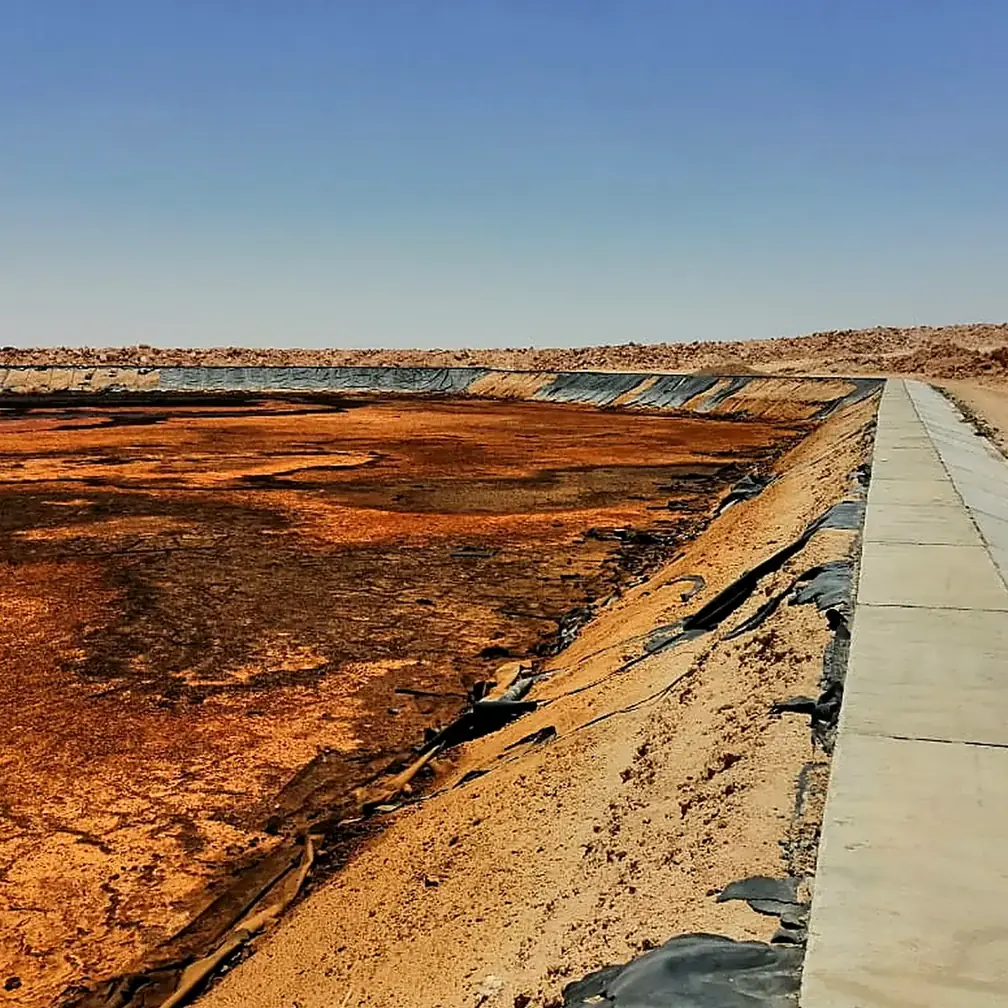
Abu Gharadig sits in Egypt’s Western Desert, in a concession where the sun is hard and water is something you store, not something you waste. An evaporation pond is part of that discipline. It holds process water in the open so the volume can drop under heat, and the lining has to keep that water in the basin instead of in the sand.
In 2021, Khalda Petroleum lined an evaporation pond of 8,000 square metres with prefabricated polyurea sheets. The work belongs to the same programme as spray polyurea on tiled roofs and foam with an acrylic finish on villa and building roofs, all described on the Khalda Petroleum project at Abu Gharadig. The application was carried out by ETS, the engineering contractor for the Khalda works, using Krypton Chemical systems from Spain.
A pond of this size is not a decorative basin. The berms are long, the floor is exposed to desert temperature swings, and the water sits for months. The lining has to be detailed at every edge, or the water finds the weak line and leaves.
| Place | Khalda concession, Abu Gharadig, Western Desert, Egypt |
|---|---|
| Client | Khalda Petroleum |
| Year | 2021 |
| Evaporation pond | 8,000 m² |
| System | Prefabricated polyurea sheets; Polyurea Rayston for spray detailing and related waterproofing |
| Applicator | ETS |
02 ·
What does an evaporation pond need from a lining?
An unlined or poorly lined basin in this climate is a slow leak. The ground cracks when it dries. Wind-blown dust sits on the floor. Process water, often with salts, sits against the lining in the heat. If you leave a seam that can open, the water will find it.
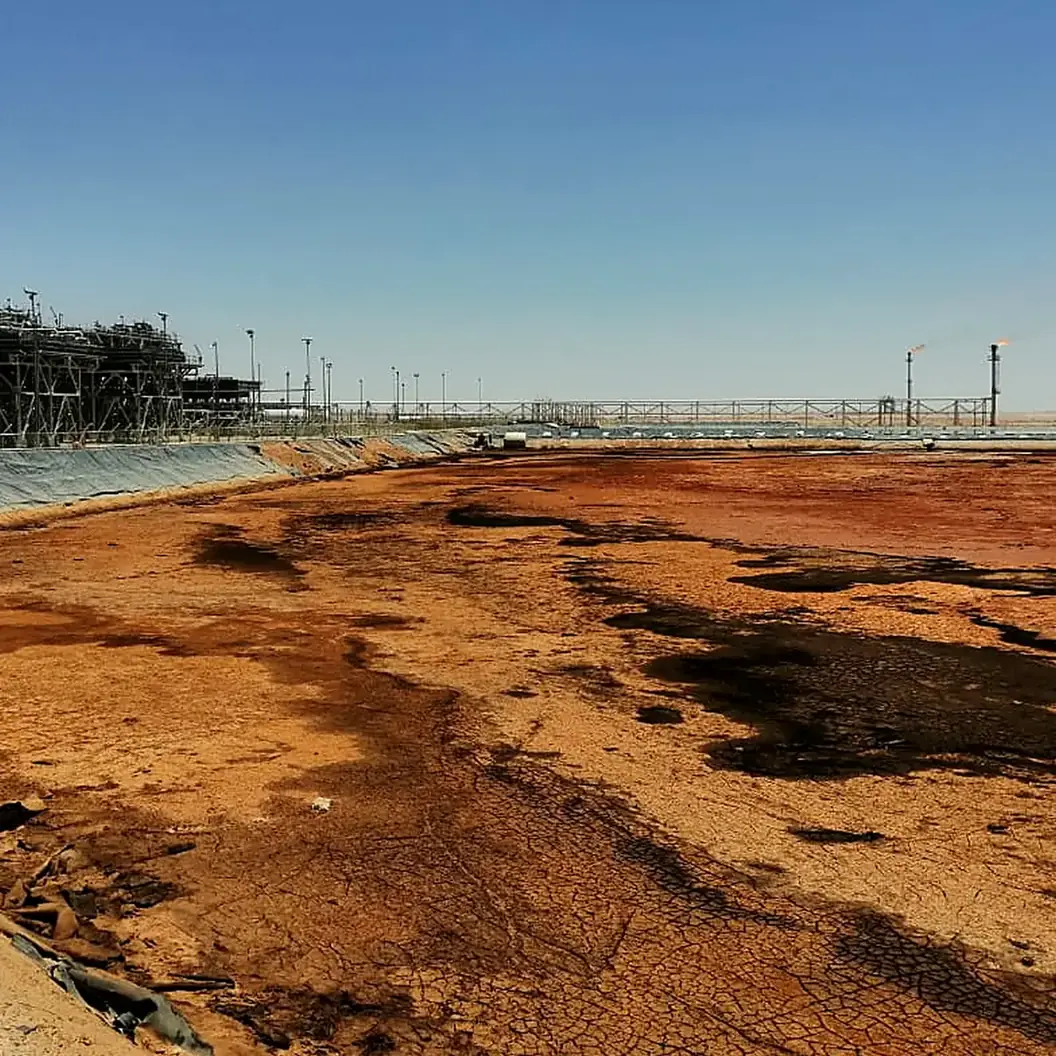
The geometry is not kind either. A pond has long berms, a concrete access way, pipe crossings and corners where a sheet has to turn up and stay tight. Prefabricated sheets have to be placed true, lapped or welded as the system requires, and closed at those edges. A spray film, where it is used to complete a detail, has to be part of the same lining, not a patch added later.
And the work has to happen on a live oilfield, under full sun, without a long cure that holds the rest of the site still.
03 ·
Which Krypton system belongs on a pond?
Polyurea Rayston is Krypton’s hot-spray pure polyurea for waterproofing. It is a two-component, 100 percent solids, extra-fast system applied with heated equipment. The technical data sheet also names ponds among its intended uses, and notes that Polyurea Rayston can be combined with geotextiles to form seamless, on-site liners for ponds, canals and secondary containment.
On this Khalda pond the field method was prefabricated polyurea sheets: factory-controlled membranes carried onto the berm and placed across the basin. That suits a wide, open pond, where a manufactured sheet can be set out over a prepared floor and then detailed at the edges. Where a spray polyurea is used to close a junction or to form a seamless liner with a geotextile, the same family of properties still matters: elasticity, speed and a film that does not rely on a weak lap.
Typical elongation is 324 percent, with a tensile strength of 16.2 MPa. Dynamic crack bridging is Class B4.2 at 23 degrees C and at -20 degrees C. Those figures are why the lining can follow a desert basin instead of tearing when the ground moves. The product carries CE marking to EN 1504-2 and European Technical Assessment 16/0148. Root resistance is tested to CEN/TS 14416. Liquid-water permeability is typically 0.002 kg/m² per square-root hour. Immersion tests place the film in the highest class against water and saturated salt water. Those are assessments of the product, not measurements taken on this pond.
Polyurea Rayston is aromatic. Sunlight can change the colour; the mechanical strength remains. An aliphatic topcoat such as Impertrans or Colodur is added where appearance under UV matters. Under water, the point of the lining is tightness, not colour.
04 ·
How do you waterproof evaporation ponds with polyurea?
The basin comes first. The support must be regular, compact and clean. For a spray application of Polyurea Rayston, the technical data sheet asks for a flat, cohesive surface, a pull-off strength of at least 1.4 N/mm², support moisture under 4 percent, and a temperature between 10 and 40 degrees C, with relative air humidity under 85 percent. Concrete is prepared mechanically, by high-pressure sand or abrasion, until the surface is open-pored. Dust is vacuumed off. Cracks are repaired before any resin goes down. If underlying moisture is suspected, the usual recommendation is two coats of an epoxy primer, the second blinded with quartz sand. Metal is cleaned and primed with a polyurethane primer. Those are typical system rules, and they are what give the lining something sound to hold.
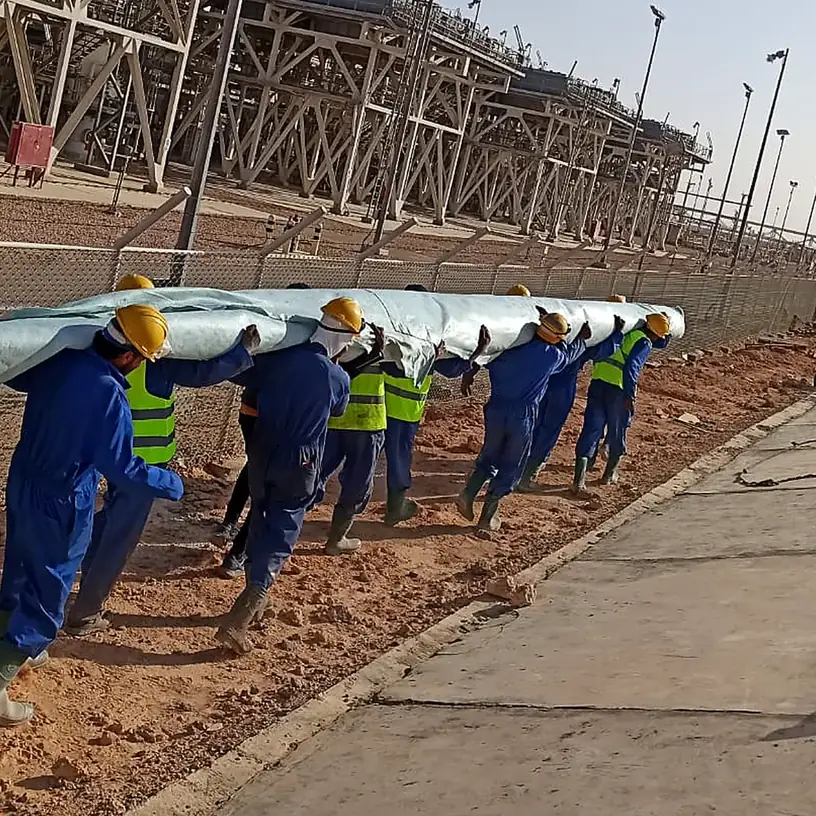
For a prefabricated sheet, the same discipline applies to the floor and the berms. The crew sets the rolls out along the access way, places each sheet true, and works the edges up the berm so the lining turns, rather than stopping short of the water line. Details at outlets and corners are closed as part of the same lining. Where a hot-spray polyurea is used to complete a seam or a penetration, the machine conditions from the data sheet are: both components preconditioned at about 25 to 30 degrees C, then applied at about 65 degrees C on component A, 75 degrees C on component B, and 65 degrees C in the hose, with spray pressure of at least 140 bar. The usual spray build is 1.5 to 2.0 kg/m², about 1.5 to 2 mm. Gel time is about four seconds at 25 degrees C. One pass should make the thickness; a second pass, if it is needed, should follow within the recoat window.
Fast curing is a real advantage on a remote oilfield. The lining can be walked for light work in a matter of hours, while full hardness still takes days. Water should wait until the membrane has the strength the job needs. That is ordinary site discipline, and it is what lets a fast lining still be there in twenty years.
05 ·
What does a well-lined pond deliver?
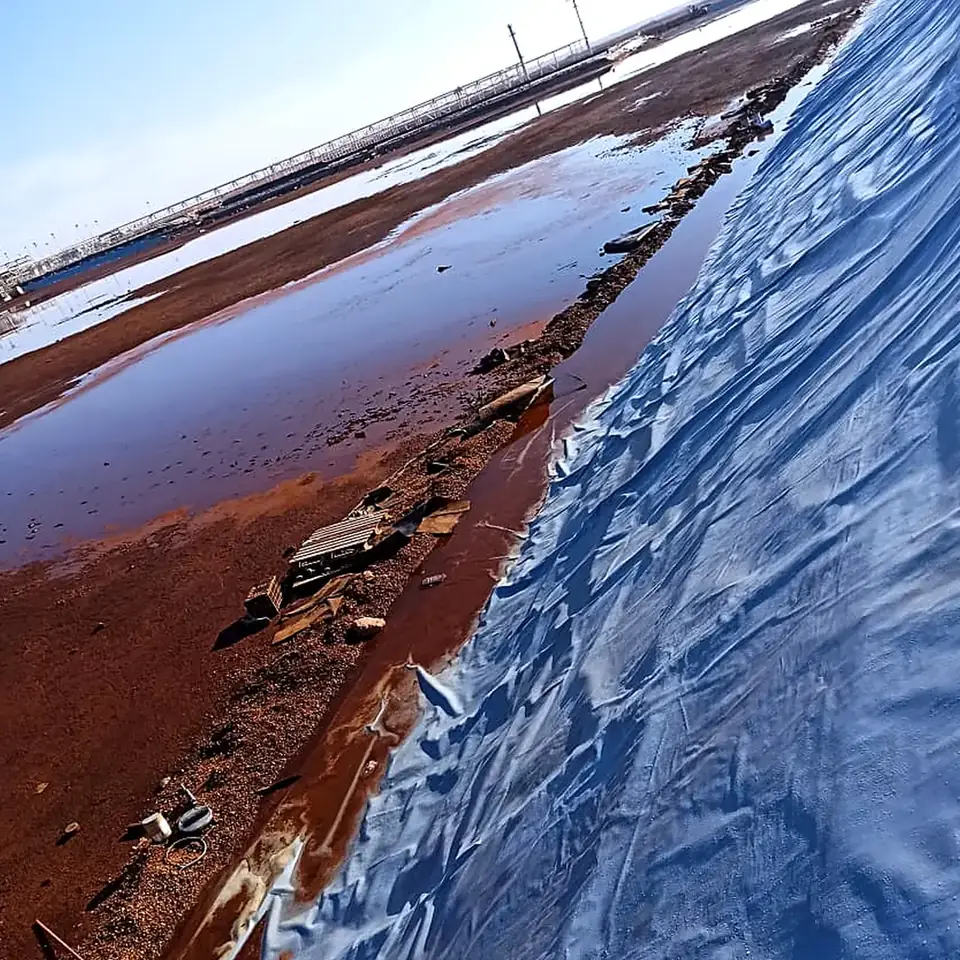
The concession keeps producing, and the water stays in the pond instead of in the sand. That is the result that matters in the Western Desert. A continuous polyurea lining, placed as sheets and closed at the berms, gives the basin a skin that can live with heat, movement and standing water.
The same programme at Khalda also sealed tiled plant roofs with spray polyurea and insulated villa and building roofs with spray polyurethane foam and an acrylic finish. The pond is the water story in that work, and it is the field case behind this guide.
06 ·
Which products are used?
Polyurea Rayston
Hot-spray pure polyurea, 100 percent solids. Typical spray build 1.5 to 2 mm. Elongation 324 percent. European Technical Assessment 16/0148. The Khalda evaporation pond was lined with prefabricated polyurea sheets; this is the Krypton polyurea system named for the concession waterproofing.
07 · FAQ
Frequently asked questions
How fast does Polyurea Rayston set?
A small mixed sample of Polyurea Rayston gels in about four seconds at 25 degrees C and is tack-free in seconds. Hardness is typically around 28 Shore A after five minutes and about 88 Shore A after four days. Those are typical figures from the technical data sheet, not readings taken on this pond.
Will the lining move with the basin?
Typical elongation is 324 percent, with a tensile strength of 16.2 MPa and tear strength around 69 N/mm. Dynamic crack bridging is Class B4.2 at 23 degrees C and at -20 degrees C. That elasticity is why a desert basin can move without opening a lap.
Can polyurea live with pond water?
Polyurea Rayston is assessed as watertight, and typical liquid-water permeability is very low, about 0.002 kg/m² per square-root hour. Immersion tests on the same data sheet place the film in the highest class against water and saturated salt water. The chemistry of a given pond still has to be checked against the product resistance table.
Does the lining need a UV topcoat?
Polyurea Rayston is aromatic, so colour can shift in sunlight while strength remains. An aliphatic polyurethane such as Impertrans or Colodur is the usual way to hold the appearance where the film stays in the sun. A buried or water-covered face is about waterproofing, not colour.
How thick is a normal spray film?
Where Polyurea Rayston is hot-sprayed, the usual application rate is 1.5 to 2.0 kg per square metre, which leaves a film about 1.5 to 2 mm thick. A prefabricated sheet follows the thickness of the manufactured liner. Neither figure is a measurement taken on this pond.
Who applied the Khalda pond lining?
The application was carried out by ETS, the Engineering Co. for Trade and Supplies.
08 ·
Where is the field case?
The field case is the Khalda Petroleum concession at Abu Gharadig, in Egypt’s Western Desert. The map marks the Abu Gharadig area used on the project article. The evaporation pond sits inside that concession.
Abu Gharadig, Western Desert, Egypt
Photos
Photos from the Khalda evaporation pond