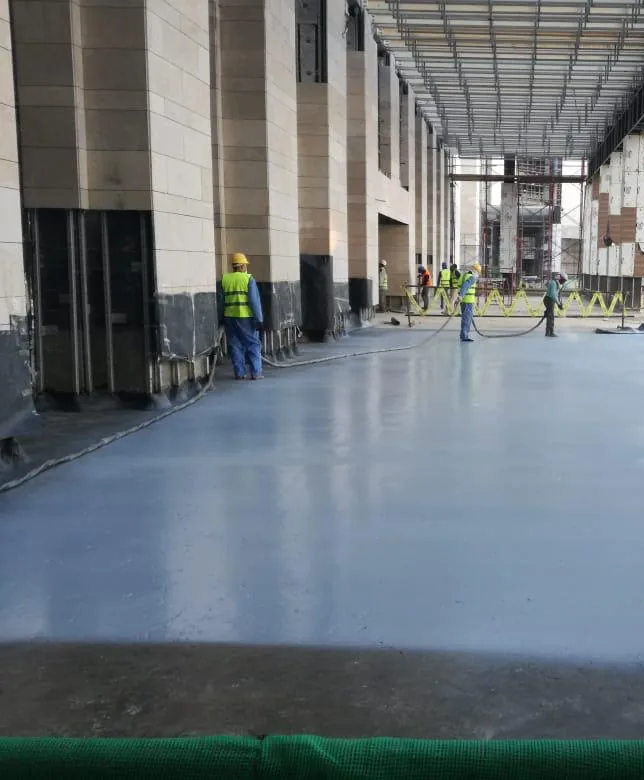
Ministries District Landscape Waterproofing, New Administrative Capital
This ministries district landscape waterproofing project sits at the heart of Egypt’s New Administrative Capital, the country’s new seat of government. Some 20,000 m² of planters, landscape areas and water features were sealed with Krypton spray polyurea and Impermax in 2020–2021.
01 · Project overview
Why does waterproofing matter so much in the Ministries District?
The New Administrative Capital is Egypt’s flagship national project. Egypt is building it in the desert east of Cairo as the country’s new seat of government. At its heart lies the Ministries District, where the government ministries now sit side by side around wide public squares, gardens and water features.
That landscape is not decoration. Above all, it is the public face of the state, and it sits on top of and around buildings that must stay dry for decades. A planter that leaks soaks the slab below, rusts the reinforcement and stains the facade. A water feature that loses water wastes a scarce resource in a desert city. So waterproofing here is long-life infrastructure, in the same league as the structure itself.
Krypton Chemical is proud that its systems were trusted on one of the most visible projects in Egypt. Over 2020 and 2021, the Cairo waterproofing contractor ETS applied Krypton spray polyurea and Impermax to about 20,000 m² of planters, landscape areas and water features in the district.
| Project | Landscape, planter and water-feature waterproofing |
|---|---|
| Location | Ministries District, New Administrative Capital, Egypt |
| Years | 2020–2021 |
| Area | 20,000 m² |
| System | Krypton pure spray polyurea + Impermax liquid polyurethane membrane |
| Applicator | ETS |
02 · Challenge
What makes planters and water features so hard to waterproof?
A roof dries out between storms. A planter never does. The membrane under a planter lives in permanently wet soil, so it must resist water around the clock, not just during rain.
Roots are the second enemy. They search for moisture and will exploit any lap, pinhole or weak bond. Then there is the soil chemistry. Irrigation water carries salts, and fertilisers add urea and ammonium nitrate, which slowly attack weaker materials.
In addition, saturated soil and water features put the membrane under hydrostatic pressure. Every planter also has upstands, inside and outside corners, drains and pipe penetrations. Each one is a detail where a sheet membrane needs a cut, a lap and a seal.
Finally, the climate is harsh. Concrete in the Egyptian desert heats up under strong sun and cools at night, so the slab moves and hairline cracks open and close. The membrane has to stretch with them and stay bonded for decades.
03 · Solution
Why spray polyurea and Impermax for the Ministries District landscape?
The answer to so many details is a liquid-applied, continuous membrane. Krypton’s pure spray polyurea is a two-component system. Applicators spray it hot, and it gels in about 4 seconds. As a result, it builds a continuous elastic skin over channels, upstands and corners in a single pass, with no laps for water or roots to find.
Pure polyurea also suits wet, buried service. It carries root resistance certification to CEN/TS 14416 and top scores in water and salt-water immersion. Moreover, it is watertight under a 50 m water column (5 bar, EN 12390-8), far beyond the head in any planter or pond.
Impermax completes the system. It is a one-component, cold-applied polyurethane membrane that goes on by roller or brush. That makes it the natural choice for small, hard-to-reach spots, edges and junctions where a spray gun is not practical. It is also highly elastic, with 450–600% elongation in its TDS, and it holds its own root-perforation certificates.
04 · Application
How is a planter waterproofed with spray polyurea, step by step?
The method below follows Krypton’s technical data sheets. The figures are typical product data.
- Open the concrete. First, the concrete is prepared mechanically by high-pressure sand or abrasion to remove laitance and open the pores. Grinding removes sharp edges, and vacuuming takes up all dust. In a planter, this bond is everything: a fully bonded membrane leaves no gap for water or roots to travel along.
- Check strength and moisture. Next, the substrate must reach at least 1.4 N/mm² in a pull-off test, with moisture below 4%. Applicators repair any crack before anything else. New planters and ponds often hold water in the concrete, so this check matters.
- Prime. Where underlying moisture is suspected, the TDS calls for two coats of Rayston Epoxy primer, the second broadcast with quartz sand. On a primed concrete substrate, the polyurea typically reaches 4.0 MPa adhesion.
- Treat the details. Then half pipes, junctions with walls, drains, joints and cracks are treated first, as the Impermax TDS requires. Impermax goes on at about 1 kg/m² per coat, with reinforcing fabric at edges and corners.
- Watch the weather. Substrate and air should stay between 10 and 40 °C, with relative humidity below 85%. In the Egyptian climate, that means spraying in the cooler hours of the day.
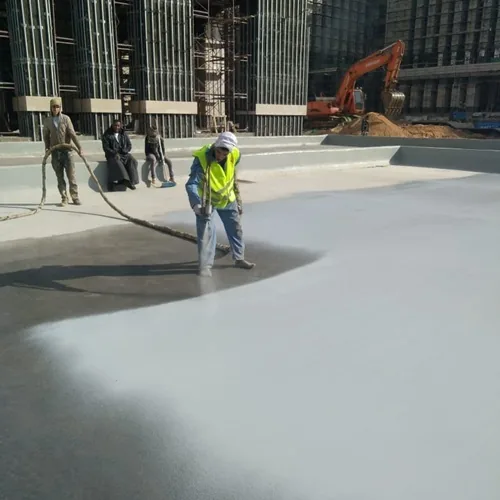
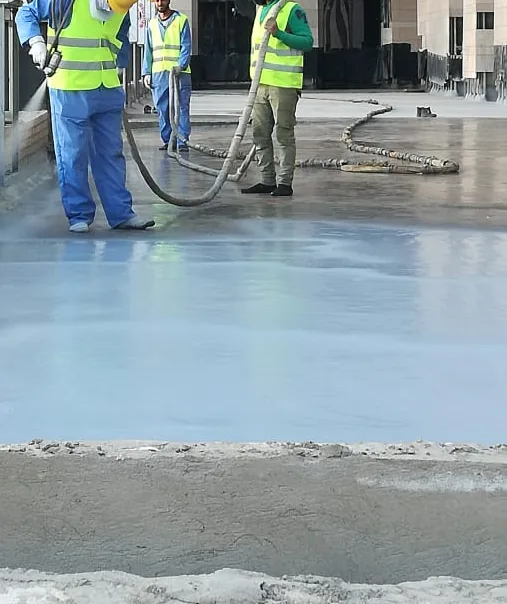
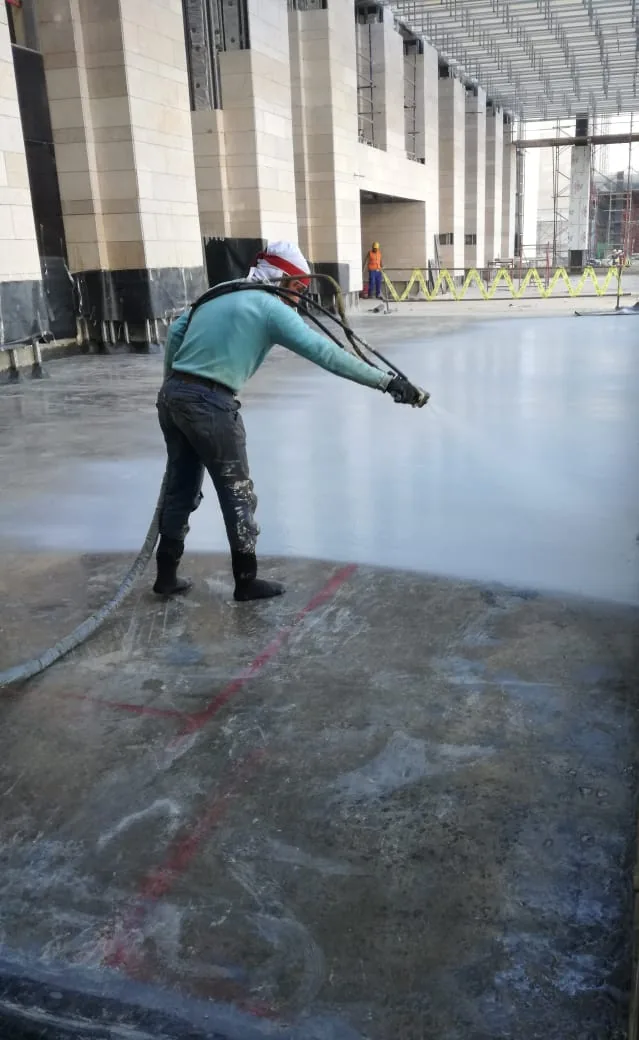
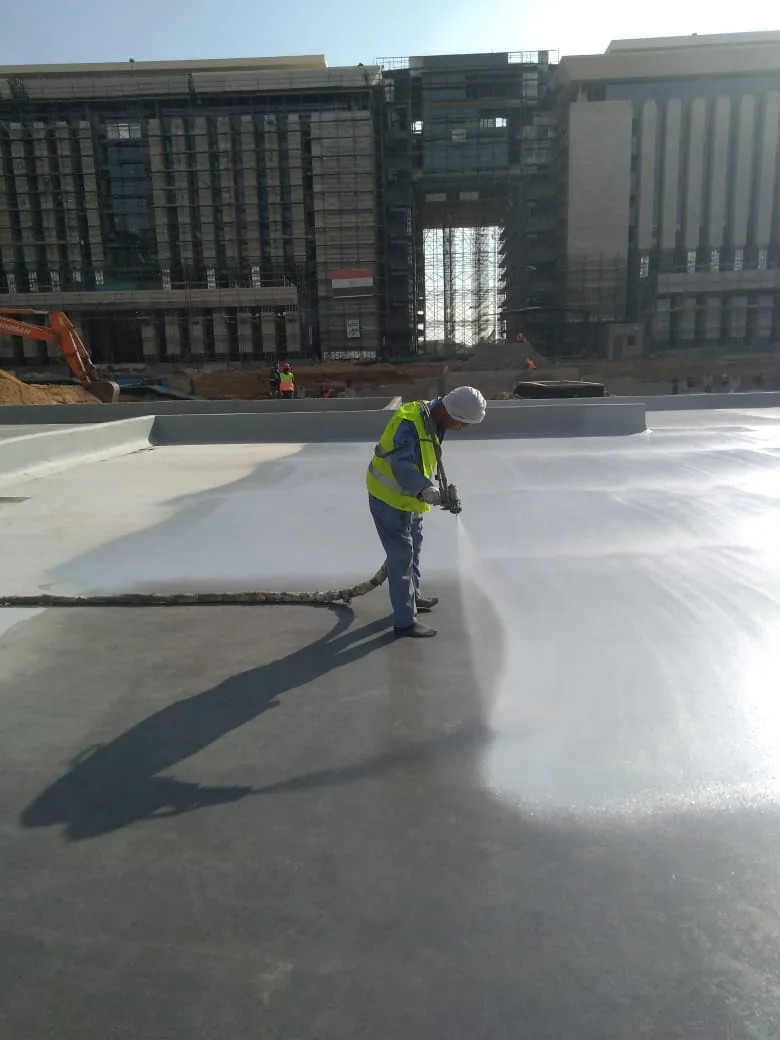
- Spray the membrane. After that, the polyurea is sprayed with hot two-component equipment: component A at 65 °C, component B at 75 °C, hose at 65 °C and at least 140 bar. It goes on at 1.5–2.0 kg/m² for a 1.5–2 mm membrane, ideally in one application.
- Cure and backfill. Finally, the membrane resists rain after about 10 minutes and reaches about 70 Shore A in 1 hour and 80 Shore A in 24 hours. Planters and water features can return to service quickly, while Impermax details need their full cure before permanent water contact.
05 · Results
What does the ministries district landscape waterproofing deliver?
As a result, the planters, landscape areas and water features of the Ministries District sit on a continuous, fully bonded membrane over some 20,000 m². Here is what that membrane brings, in typical TDS values, and why each one matters for this landscape:
- Crack bridging: class A5 at −10 °C (static) and B4.2 at 23 and −20 °C (dynamic). Daily heating and cooling of the slab will not tear the membrane.
- Elasticity and strength: 324% elongation, 16.2 MPa tensile strength and 69 N/mm tear strength. So it can take soil loads, tools and backfill without damage.
- Watertightness: watertight at 5 bar (EN 12390-8), with liquid water permeability of only 0.002 kg/m²·h0.5. That is ample for permanently saturated soil and full ponds.
- Chemistry of the soil: top score (5 of 5) in water, saturated salt water, urea and ammonium nitrate immersion. Fertilised, salty irrigation water does not weaken it.
- Heat: Vicat softening at 118 °C and decomposition above 300 °C, well above any desert surface temperature.
In short, Krypton’s systems turned a landscape full of difficult details into one continuous waterproof skin. That is the kind of result a national government district needs. For similar work, see our plaza planter waterproofing in Monterrey and the pure polyurea membrane guide.
06 · Products
Which Krypton products were used?
Krypton pure spray polyurea
Role here: main continuous membrane for planters, landscape areas and water features. Typical data from the Polyurea Rayston TDS, Krypton’s pure spray polyurea.
- Gel time about 4 s at 25 °C; rain-resistant after about 10 min
- 1.5–2.0 kg/m² for 1.5–2 mm
- Elongation 324%; tensile strength 16.2 MPa
- Root resistance to CEN/TS 14416
Technical data sheet (PDF) · Product page on kryptonchemical.com
Impermax
Role here: cold-applied liquid polyurethane membrane for details, edges and hard-to-reach areas. Typical data from the Impermax TDS.
- One component, roller, brush or airless
- 2 coats at 1 kg/m² each
- Elongation 450–600%; 2.0 MPa bond to concrete
- Root-perforation certificates, with and without reinforcement
Technical data sheet (PDF) · Product page on kryptonchemical.com
Certifications
- Krypton pure spray polyurea (Polyurea Rayston): CE marking to EN 1504-2 (0370-CPR-2247), ETA 16/0148, BBA 18/5582, root resistance to CEN/TS 14416, WRAS approval 2208579, EPD-IES-0020897, external fire Broof(t1).
- Impermax: ETA 06/0263 with CE marking, root perforation resistance (Nº 07/32305556, and reinforced versions), BBA 11/4836, BROOF(t1) for any roof slope.
07 · FAQ
Frequently asked questions
Why use spray polyurea in planters instead of sheet membranes?
A sprayed polyurea forms one continuous membrane with no laps or seams. In a planter, every lap is a path for water and roots, and every corner or upstand needs a detail. Krypton’s pure polyurea follows the shape of the concrete, bonds fully to the primed substrate and cures within seconds, so even complex planter geometry ends up as a single watertight skin.
Can roots damage the membrane?
Root resistance is the first thing to check in any planter. Krypton’s pure spray polyurea passes root resistance testing to CEN/TS 14416, and Impermax carries its own root-perforation certificates, with and without reinforcement. Both membranes are fully bonded, so a root cannot travel between the membrane and the concrete.
Do fertilisers and irrigation water attack polyurea?
Not in normal landscape use. In the TDS immersion tests, Krypton’s pure polyurea scores 5 out of 5 (best) in water, saturated salt water, urea and ammonium nitrate, which are the main nitrogen fertilisers found in planter soil.
How soon can soil go back into a planter after spraying?
Krypton’s pure polyurea is rain-resistant after about 10 minutes and reaches around 80 Shore A after 24 hours at 25 °C, 50% relative humidity (typical TDS data). Areas finished with Impermax need longer: walking is usually possible after 1 to 2 days, and the TDS recommends waiting 10 to 15 days before permanent water contact.
Does the membrane need UV protection?
Both products are aromatic, so they change colour in sunlight without losing their mechanical properties. Under soil and water there is no UV exposure. Where a rim or upstand stays exposed to the Egyptian sun, the TDS recommends an aliphatic topcoat such as Impertrans or Colodur.
How is a planter membrane maintained?
The maintenance routine is simple. Keep drains and gratings clear, remove leaves and stray plants from outlets, and check flashings and upstands. To repair damage, cut out the area and apply fresh product, which bonds to the existing membrane.
08 · Photos
Ministries District planters: the works