
Home / Knowledge / Almansa swimming pool with Polyurea Rayston and Paintchlore 2K
Almansa swimming pool with Polyurea Rayston and Paintchlore 2K
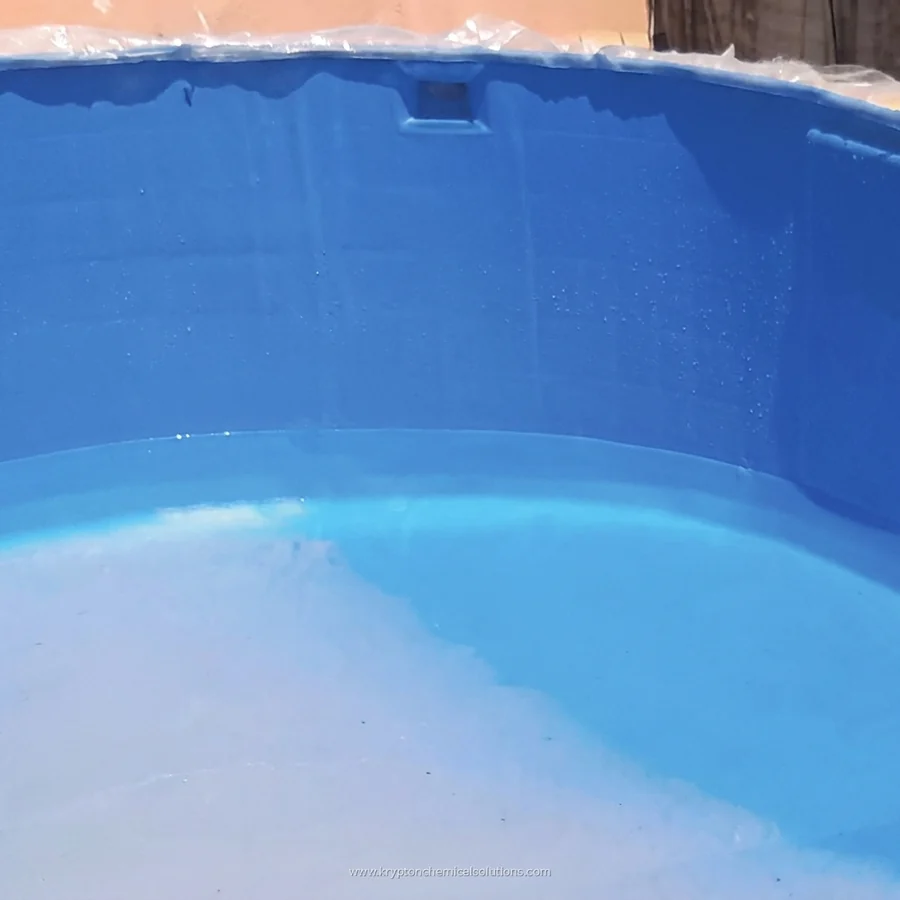
A 110 m² private pool in Almansa (Albacete), finished with Paintchlore 2K (two-component acrylic-PU hybrid) as the chlorinated-water coat over Polyurea Rayston (pure polyurea).
Paintchlore 2K (two-component acrylic-PU hybrid, aliphatic isocyanate) is the finish used on a leaking 110 m² private pool in Almansa, Albacete, over Polyurea Rayston (100% pure polyurea). The system was applied over the existing ceramic tiles. The colour of the water in a photograph says nothing about chlorine resistance.
The Almansa pool build-up
Magazine No. 3 describes a three-step system on the existing ceramic. The header names Rayston Epoxy 100 Gel (transparent two-component solvent-free epoxy sealer). The sequence was priming with EPOXY 100 by airless, then POLYUREA RAYSTON as the intermediate membrane, then PAINTCHLORE 2K by airless. The magazine also spells it “Paintclhore”; the catalogue name is Paintchlore 2K.
Paintchlore 2K is always supplied coloured and is designed for immersion in chlorinated and salt water. Polyurea Rayston carries CE EN-1504-2, ETA ETAG005 16/0148, BBA 18/5582 and WRAS BS6920. Where the polyurea is exposed to UV, an aliphatic topcoat is still required. Consumption is given in the current TDS; the calculator then helps you estimate quantities.
More on this application is on the swimming pools application page and the Paintchlore 2K product entry, with data sheets in documents.
External reference: CEN-CENELEC.
For a similar pool, identify the ceramic substrate and specify Polyurea Rayston with Paintchlore 2K as the chlorinated-water finish.
This article is general technical guidance from Krypton Chemical and does not replace the current technical data sheet (TDS), the safety data sheet (SDS) or the project specification. Pack sizes, mix ratio and consumption in kg/m² are given in the current TDS; with those figures, the calculator helps you estimate quantities for your area.