
Home / Knowledge / ProLine NE 500 novolac epoxy in hydrocarbon immersion
ProLine NE 500 novolac epoxy in hydrocarbon immersion
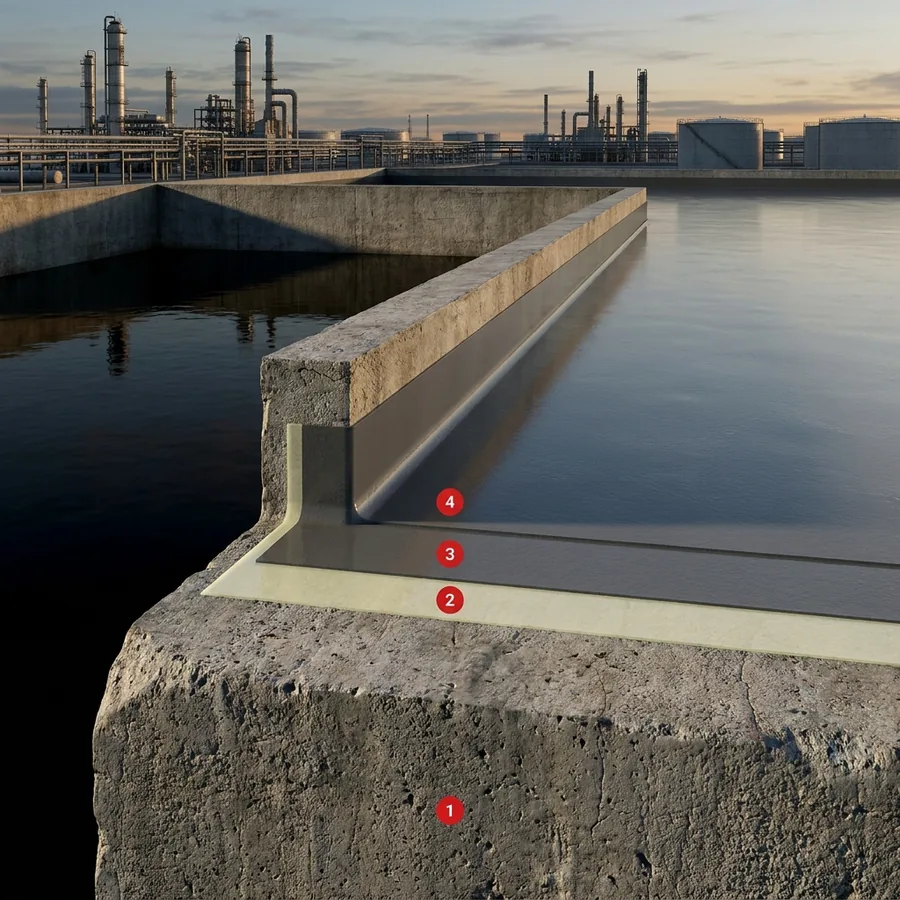
ProLine NE 500 novolac is a named epoxy lining. It is not a polyurea and not a C5H zinc-MIO system.
Specify ProLine NE 500 novolac when the lining sits in hydrocarbons. Krypton ProLine NE 500 (novolac epoxy, 78 percent volumetric solids) is written for steel and concrete in contact with chemical compounds, especially hydrocarbons, in continuous immersion. Catalogue 2026 recommends it for the inside of tanks and pipes (acids, gasoil).
What ProLine NE 500 novolac actually claims
Catalogue 2026 cites thermal resistance with dry heat up to 200 °C and immersion resistance up to 100 °C. The recommended system is two layers, read as dry-film build on the current TDS. Keep those temperatures on NE 500. Do not move them onto Krypton ProLine MFE 100 (surface-tolerant multifunctional epoxy), which is a primer or intermediate, not this immersion lining.
However, this is not ProLine C5H steel (PU ZN Primer plus AC MIO plus PU 1000 TC). This is not Krypton ProLine CH55. An oil-and-gas photograph is not a roof membrane. Microns stay on the current sheet, then the calculator sizes the area.
See Krypton ProLine NE 500, oil and gas / petrochemical, liquid containment and documents. Area is sized on the calculator.
Outbound reference: ISO 12944.
A tank interior is not a parking floor. Keep ProLine NE 500 novolac on the epoxy the catalogue names.
Therefore mix ratio stays on the sheet. First name the hydrocarbon. Next name NE 500. Also keep C5H off this clause.
These notes do not replace the current TDS, SDS or a written specification. For pack sizes, mix ratio and kg/m², read the current sheet, then the calculator.