Capital Business District Waterproofing, New Administrative Capital
The Capital Business District in Egypt’s New Administrative Capital was waterproofed as four duties: EPDM on foundations, retaining walls and water features; hot-spray pure polyurea and a two-component polyurethane in the tanks; a cementitious coating in the wet areas; and polyurea on the roofs.
Overview
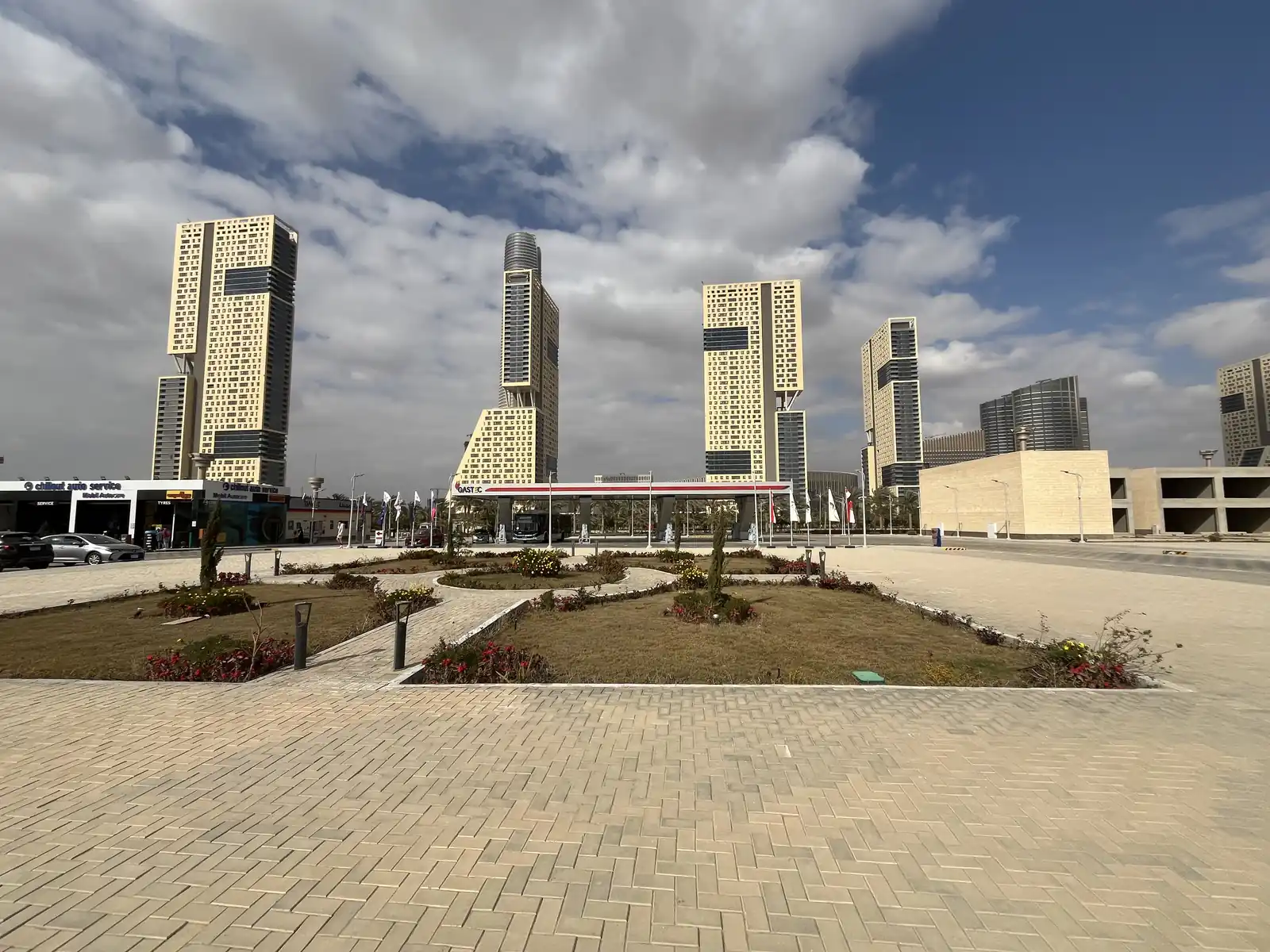
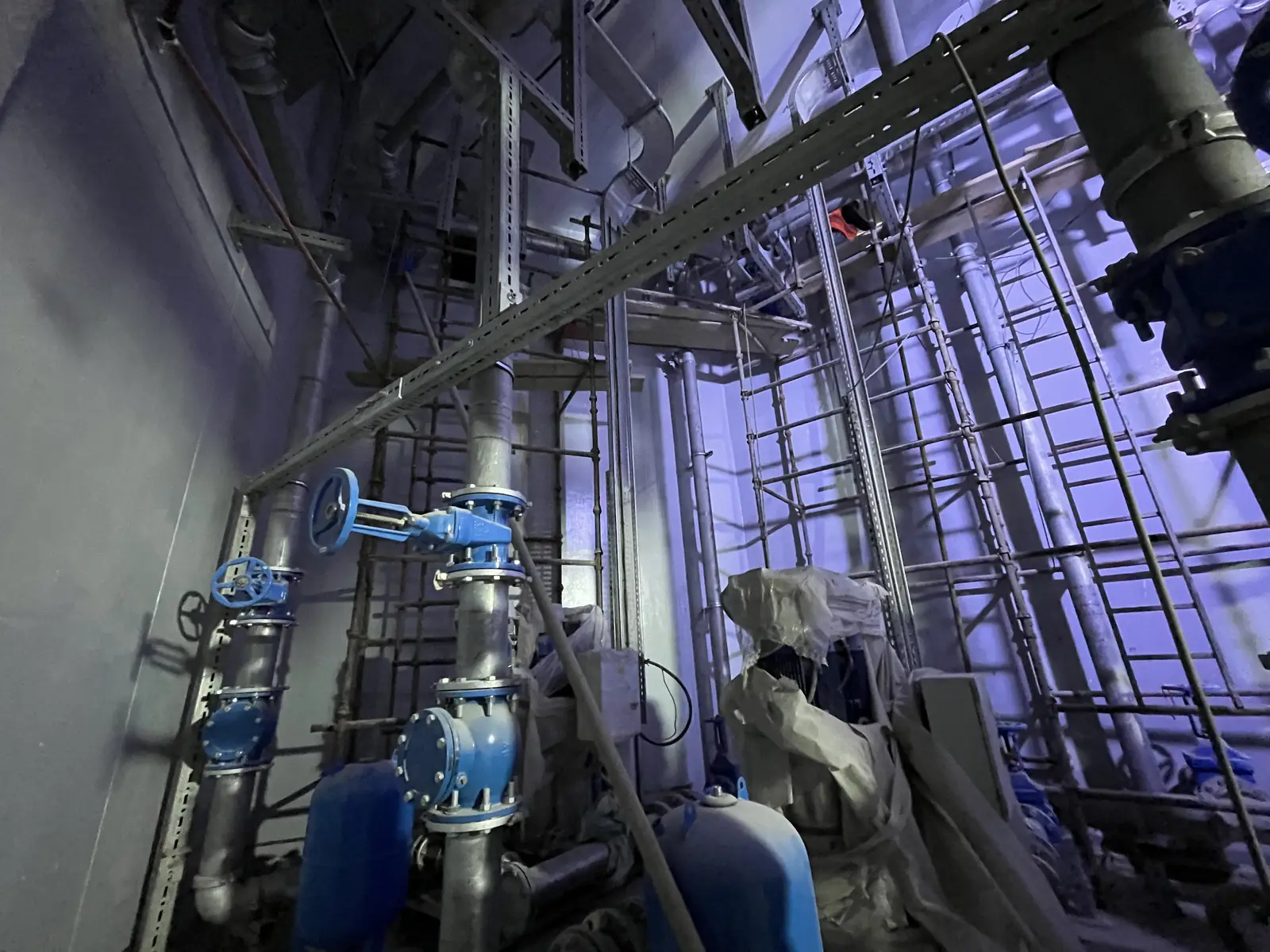
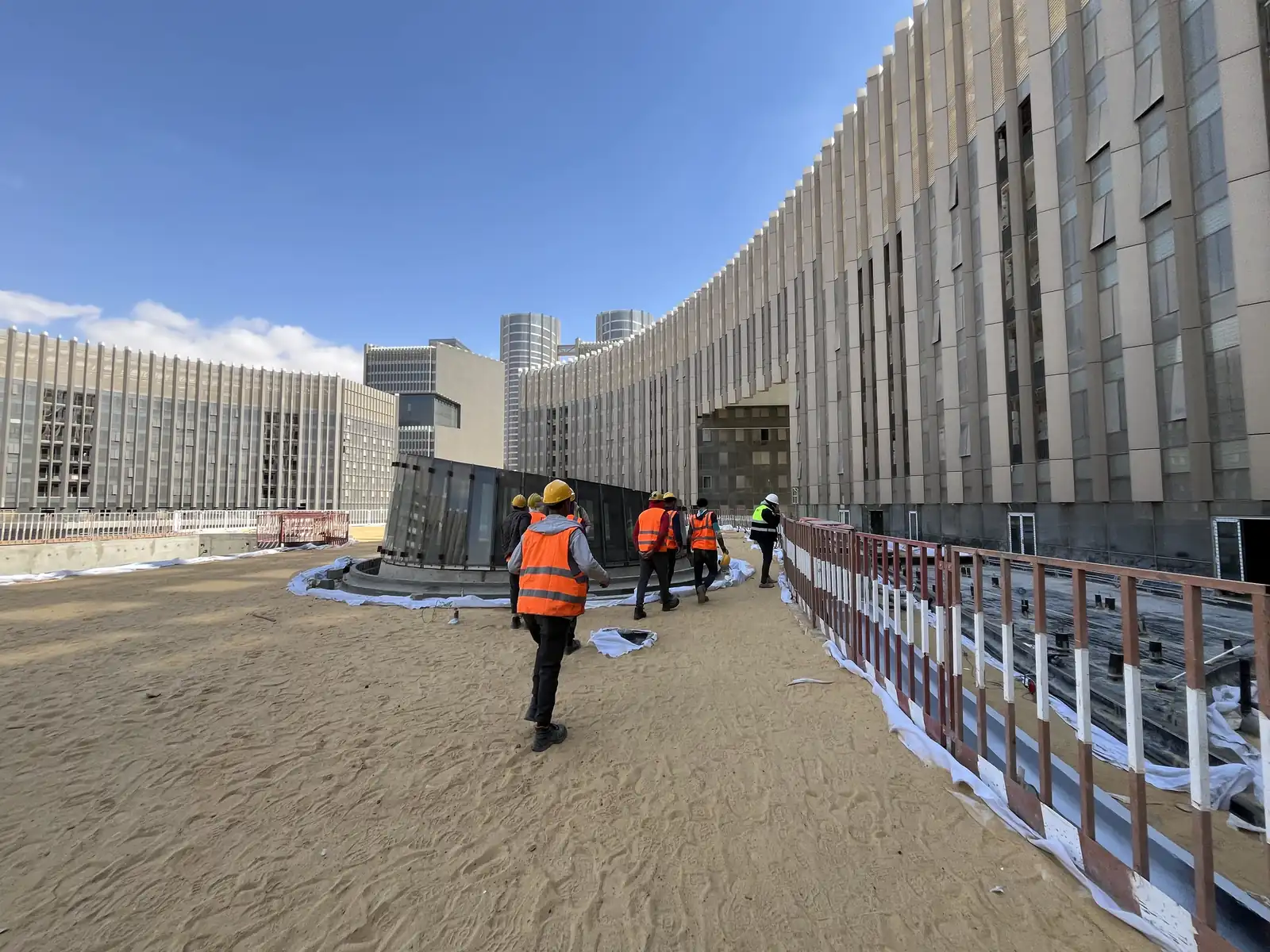
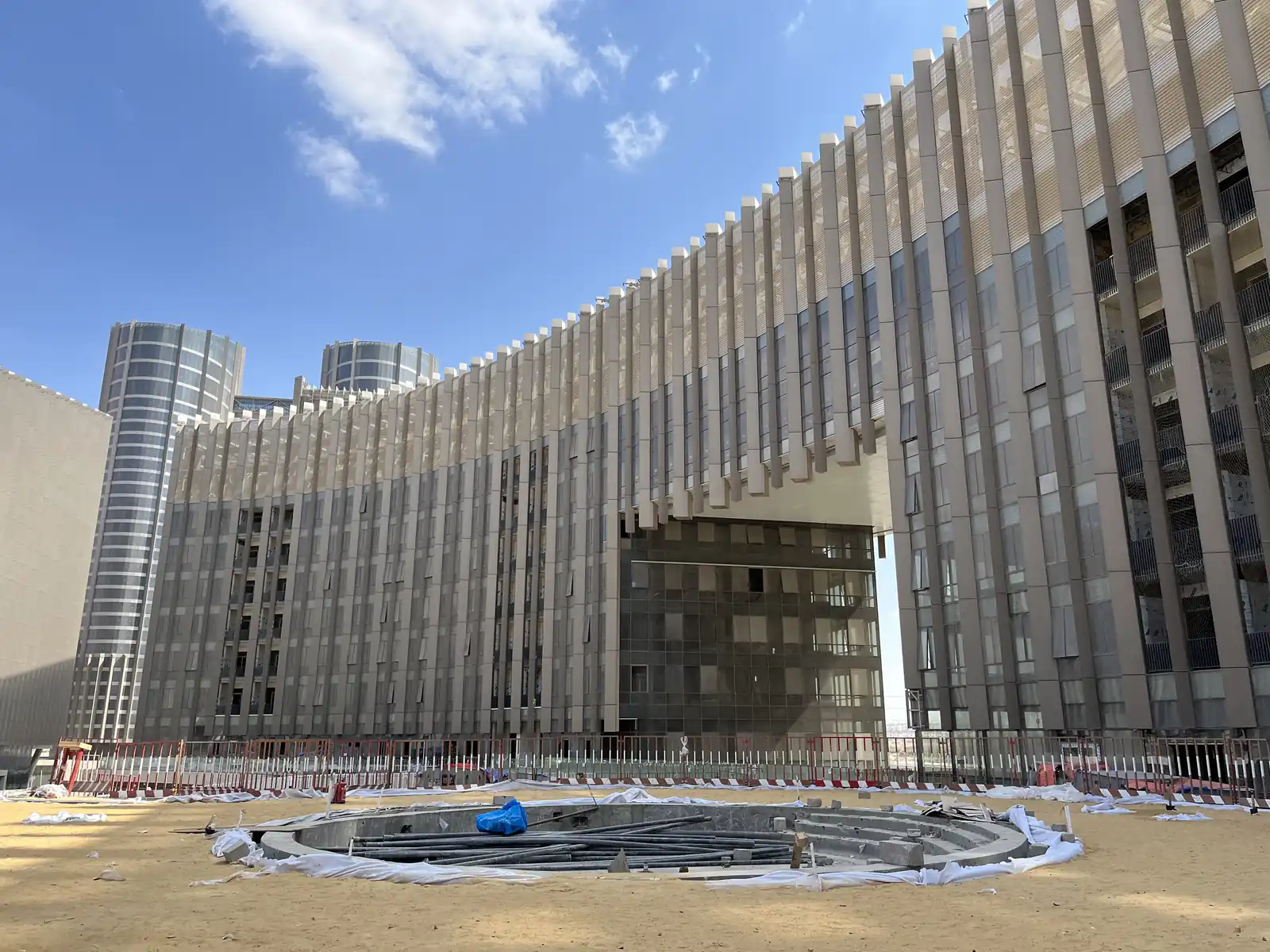
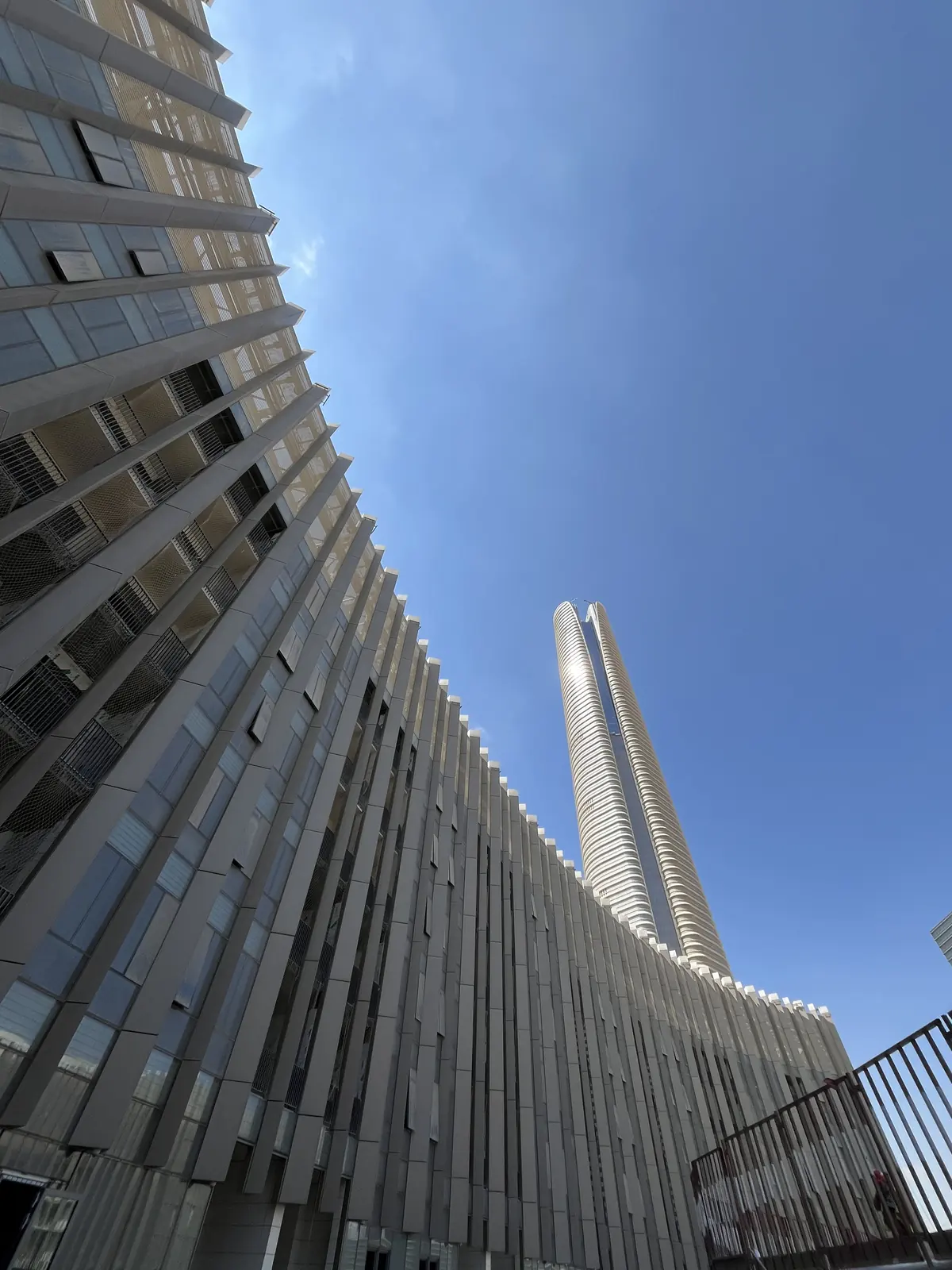
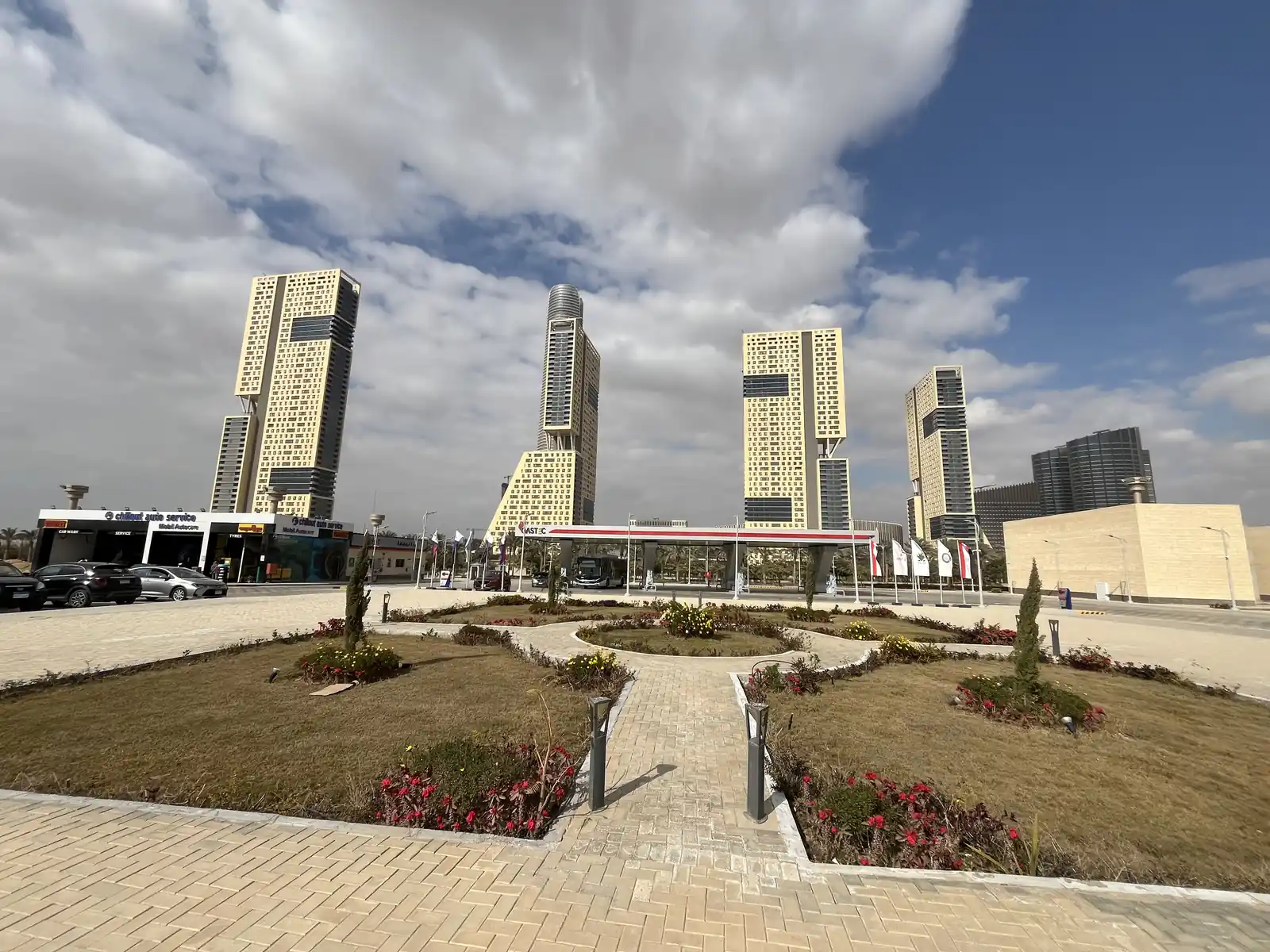
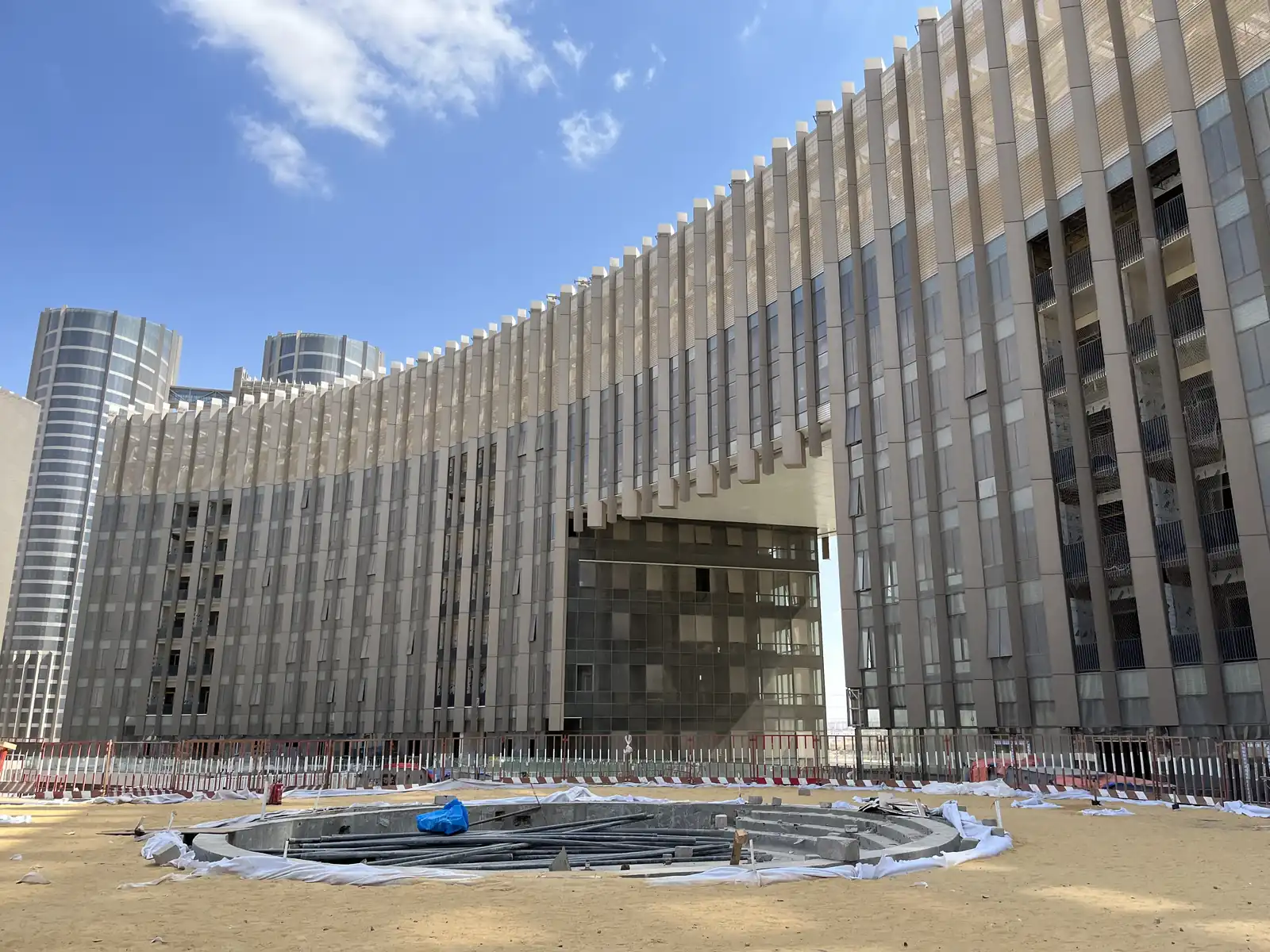
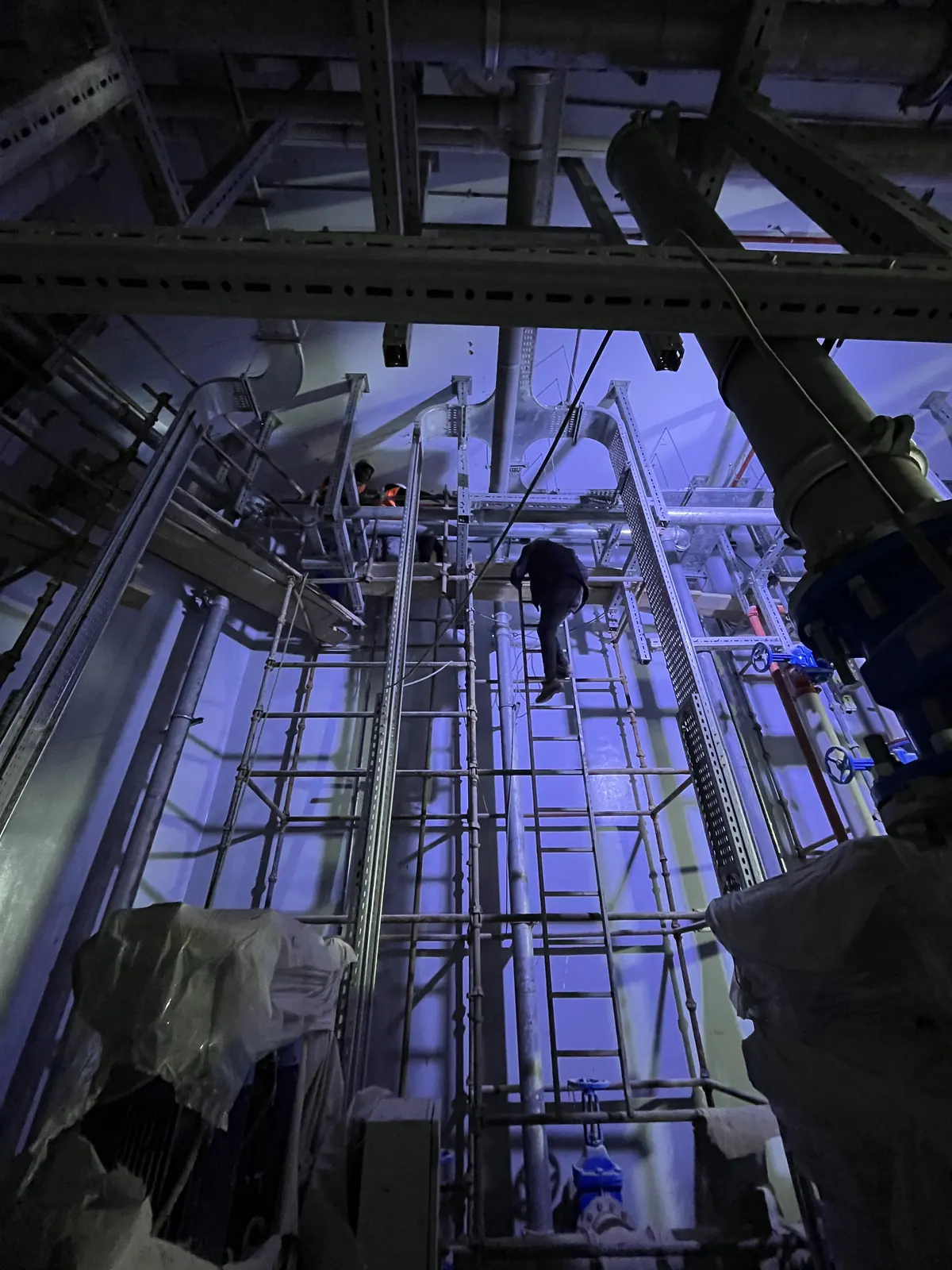
The Capital Business District is the commercial core of the New Administrative Capital, east of Cairo. Towers stand over a podium, a planted court, and plant rooms that nobody visits until something leaks. Waterproofing here is buried: under landscape, behind retaining walls, inside tanks, and on roofs that will be walked by maintenance crews only.
Krypton Chemical makes the sprayed resins. The district also carries systems that are not those resins, and they should stay named as they were specified. EPDM for the foundations, the retaining walls and the water features. Cementitious coating for the wet areas. Hot-spray pure polyurea and a two-component polyurethane for the tanks. Polyurea for the roofs.
| Place | Capital Business District, New Administrative Capital, Egypt |
|---|---|
| Foundations, retaining walls, water features | EPDM |
| Tanks | Hot-applied pure polyurea and two-component polyurethane |
| Wet areas | Cementitious coating |
| Roofs | Polyurea |
The Iconic Tower tanks, in this same district, are written up on their own page: Iconic Tower tank waterproofing.
Challenge
A business district is a stack of different water problems. Foundations and retaining walls sit in soil that stays damp. A water feature holds water on purpose, in the sun, with a joint every few metres. A tank never dries, and its outlets are the first place a lining fails. A wet room wants a coat that lives with tiles and cleaning water. A roof wants a film that follows a concrete deck through a New Capital afternoon.
One product does not answer all of that. A sheet on a foundation is the wrong tool inside a tank. A cementitious coat on a roof is the wrong tool under soil. The district was split by duty, and each duty keeps its own system.
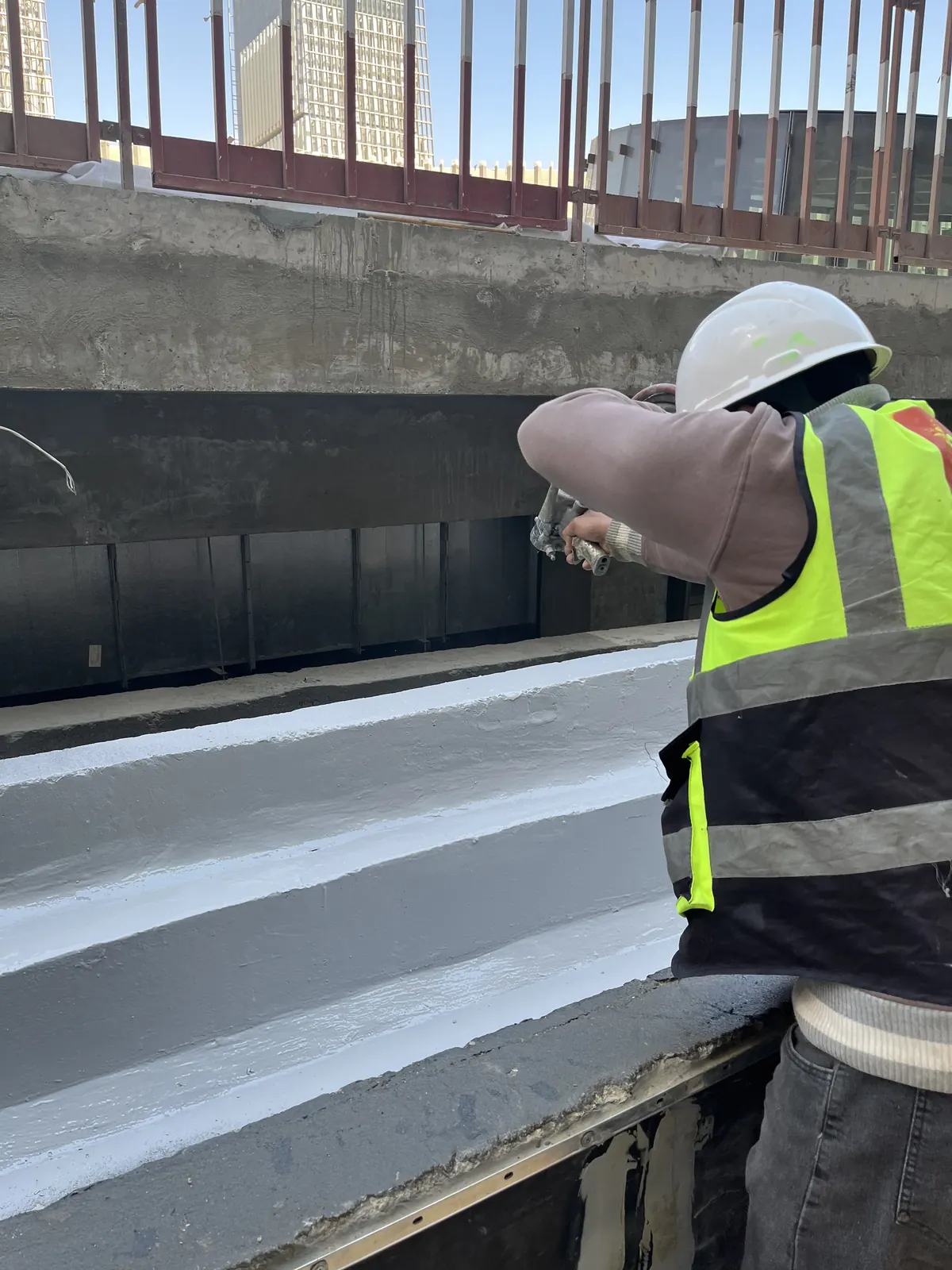
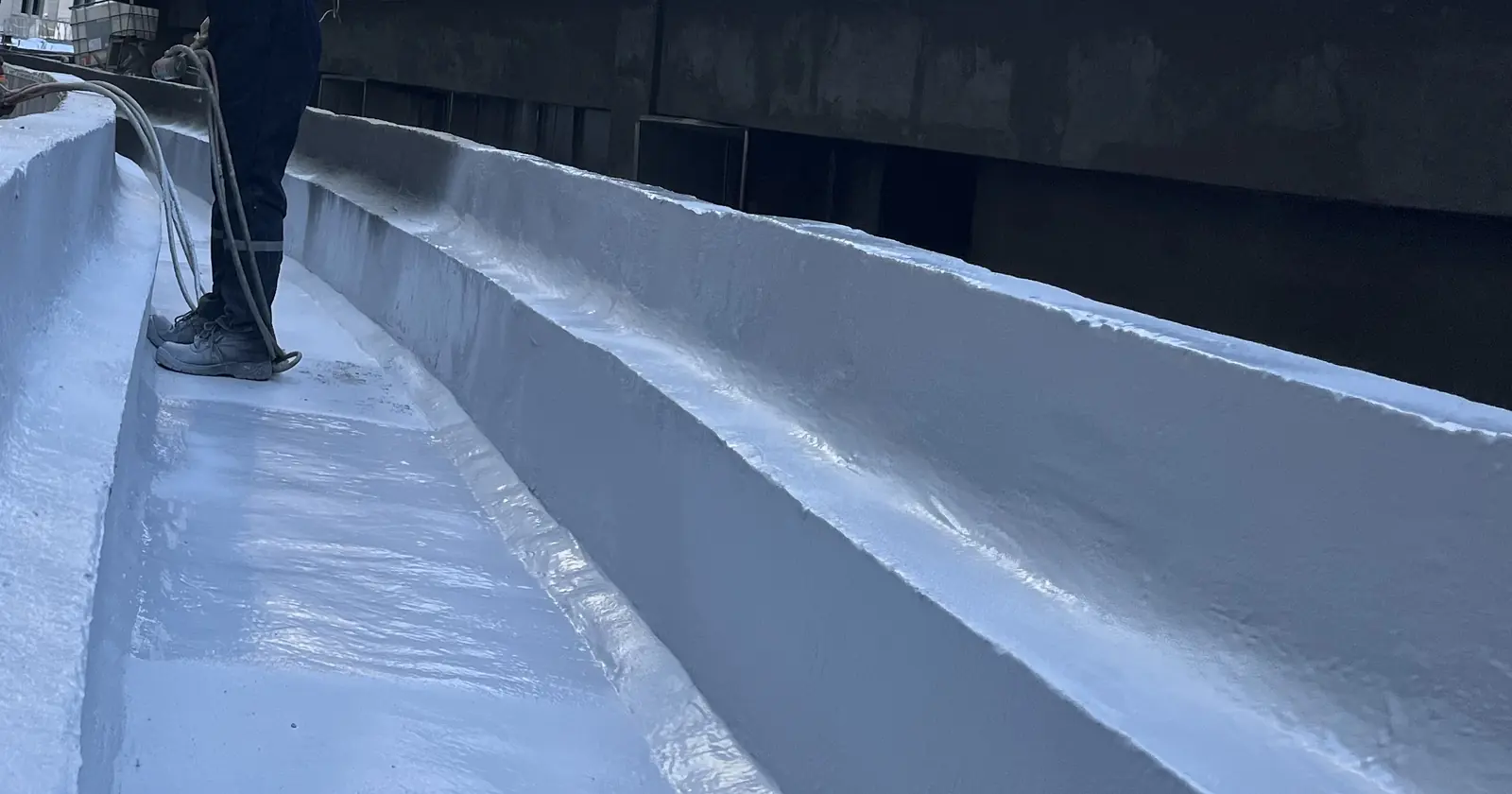
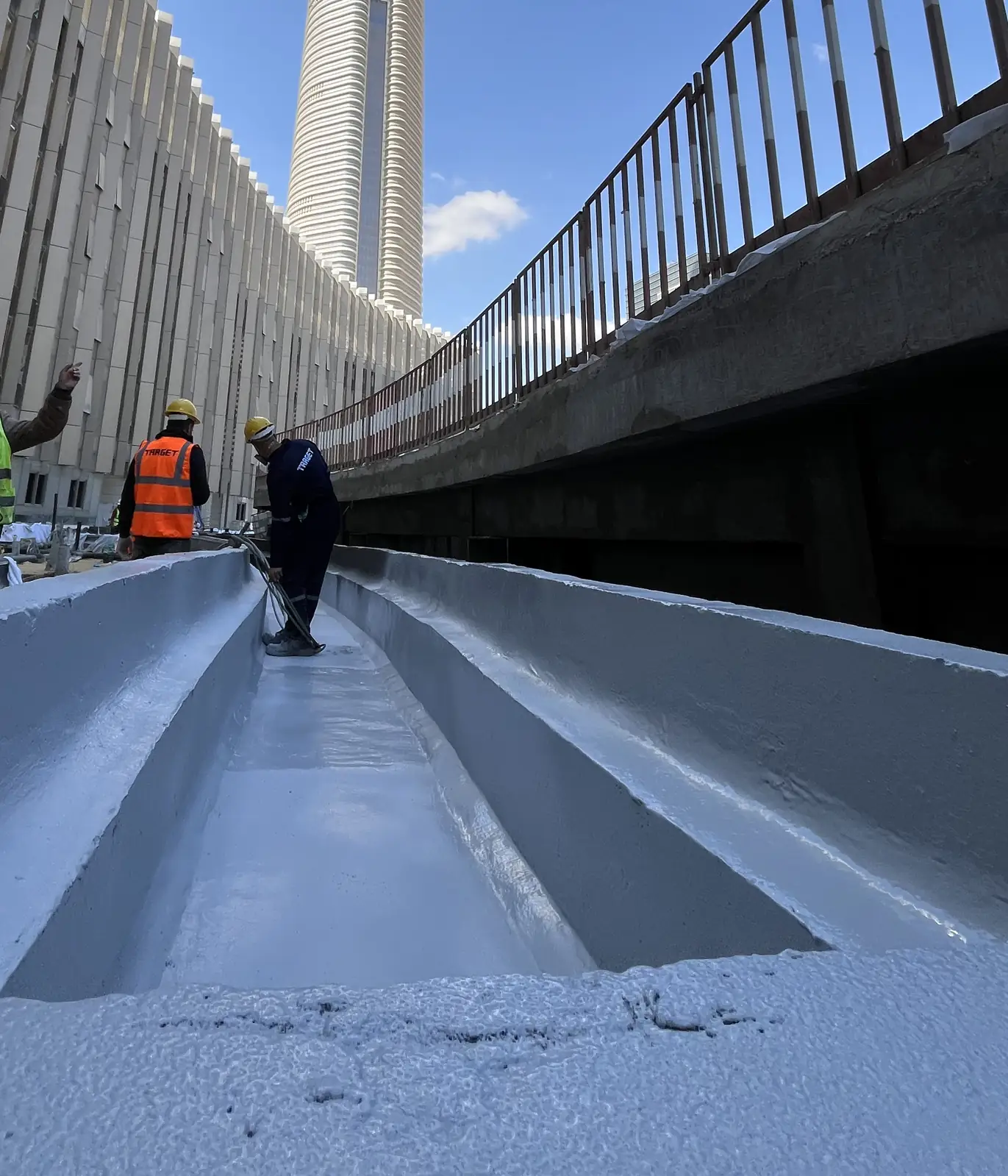
The sprayed work shows on the podium channels: a light membrane laid into a long gutter at the edge of the deck, with the towers behind it. That channel takes the water the plaza sends it. If the film is thin at the bend, the ceiling below finds out.
Solution
Foundations, retaining walls and water features: EPDM. A sheet membrane, laid and jointed, for structures in permanent contact with ground or with a pool of water. It is not the Krypton spray. It is the system named for that line, and it stays that.
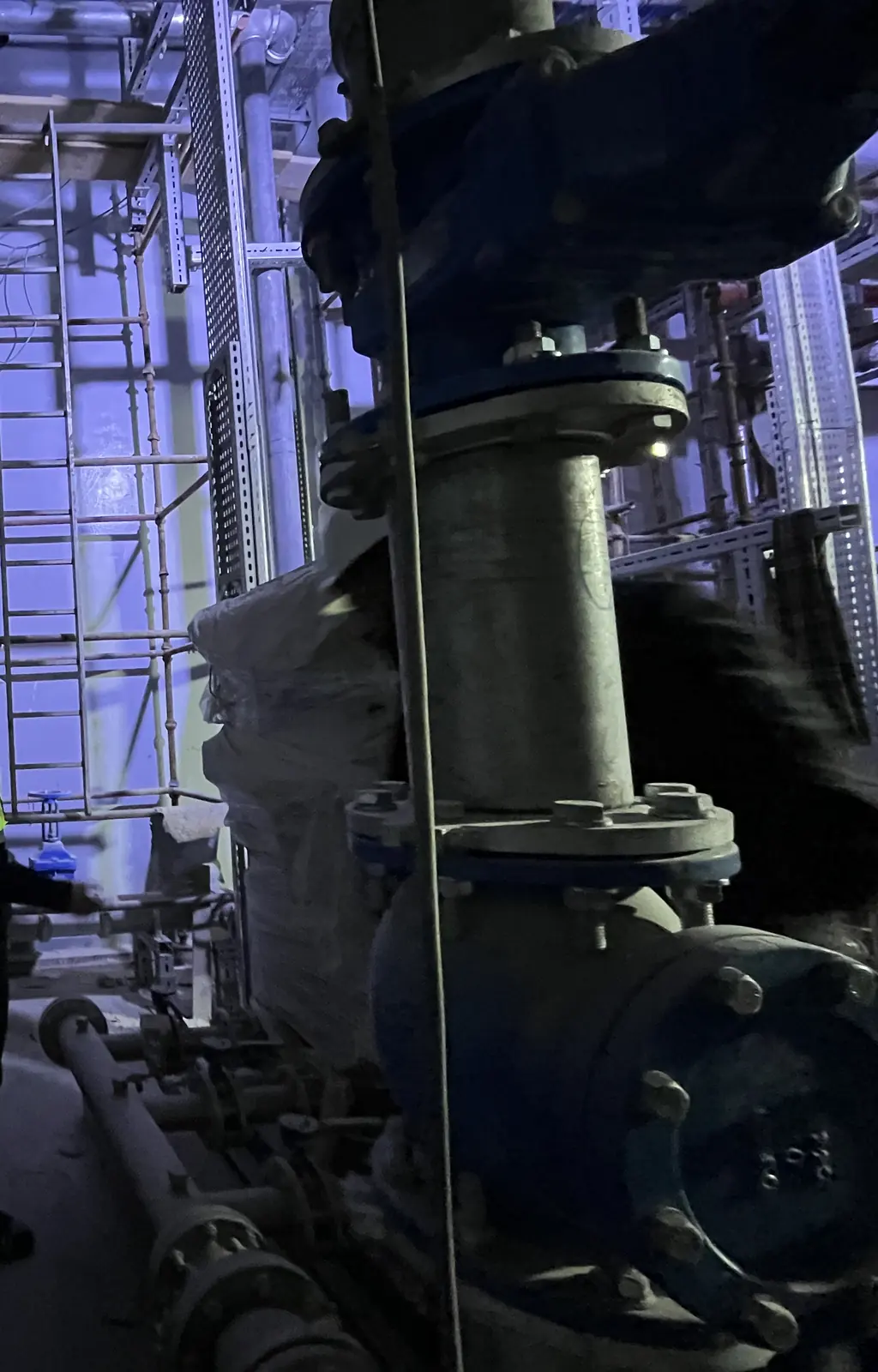
Tanks: Polyurea Rayston, hot-sprayed pure polyurea, together with Impermax 2K, the two-component polyurethane, also hot-sprayed. Polyurea Rayston gels in about 4 seconds at 25 degrees C. The typical film is 1.5 to 2 mm from 1.5 to 2.0 kg per square metre, elongation about 324 percent, tensile strength about 16.2 MPa. Impermax 2K is sprayed at about 1.8 to 2.0 kg per square metre for a minimum of about 1.9 mm, elongation about 350 percent, tensile strength about 13 MPa, Shore 83A. The pure polyurea is the immersion lining. The two-component polyurethane is the second hot-spray resin on the same tanks.
Wet areas: a cementitious coating. Mineral, for rooms that stay humid. No spray machine, no sheet.
Roofs: polyurea. Same family as the tank lining, on a deck that moves in the sun. Elongation is what the roof is buying. An aliphatic topcoat holds the colour where the roof stays exposed, because aromatic polyurea can shift shade without losing strength.
Application
The sprayed resins share a discipline. Concrete pull-off at least 1.4 N/mm2 for the polyurea, moisture under 4 percent, surface between 10 and 40 degrees C. Open the pore, repair cracks, vacuum the dust, prime where the datasheet says so. Metal outlets are cleaned and primed. A plant room full of flanges is a room full of details.
Polyurea Rayston: component A at 65 degrees C, component B at 75 degrees C, hose at 65 degrees C, pressure at least 140 bar. Impermax 2K: component A at 60 degrees C, component B at 70 degrees C, hose at 65 degrees C, pressure at least 140 bar. Both are two-component hot spray. They are not interchangeable in the gun. The drums are preconditioned around 25 to 30 degrees C, and the amine side is pigmented before it is loaded.
On the podium the pass goes into the channel, up the sides, and through the bend. The field of a roof is the easy pass. The channel and the outlet are the pass that decides the ceiling. Wind over about 25 km/h upsets the Impermax 2K spray. On an open podium in the New Capital that is a real stop-work, not a footnote.
EPDM is a different crew and a different day: sheets, joints, and details at penetrations, on the foundations and the water features. The cementitious coat is rolled or trowelled in the wet rooms, onto a damp-stable mineral base. Neither of those is checked with a spray thickness gauge.
Results
The district stands with its towers over a planted court and a podium. Under that, the scopes stay separate. EPDM on the ground-contact line and the water features. Hot-spray pure polyurea and Impermax 2K in the tanks, including the Iconic Tower tanks already published. Cementitious coating in the wet areas. Polyurea on the roofs. The podium channels carry a sprayed light membrane into the gutter that takes the plaza water.
Krypton Chemical’s part is the sprayed resins and the build their datasheets set. The EPDM and the cementitious coat are the other lines on the same job, kept under their own names.
Products
Polyurea Rayston
Hot-spray pure polyurea for the tanks and the roofs. Typical 1.5 to 2 mm. Gel about 4 seconds at 25 degrees C. Elongation about 324 percent.
Impermax 2K
Two-component polyurethane, hot-sprayed, on the tanks with the polyurea. About 1.9 mm from 1.8 to 2.0 kg per square metre. Elongation about 350 percent.
EPDM and cementitious coating
EPDM on foundations, retaining walls and water features. Cementitious coating in the wet areas. Named on the project as those systems, not as the spray resins.
FAQ
Why two hot-spray resins in the tanks?
Pure polyurea (Polyurea Rayston) is the immersion lining: gel in about 4 seconds at 25 degrees C, about 1.5 to 2 mm, elongation about 324 percent. Impermax 2K is the two-component polyurethane sprayed hot as well, typically 1.8 to 2.0 kg per square metre for about 1.9 mm, elongation about 350 percent. One is the tank film. The other is the polyurethane that goes with it on this project.
What is EPDM doing on the foundations?
Foundations, retaining walls and the water features on this district were specified in EPDM. That is a sheet system, a different duty from the sprayed tank lining. The spray gun is not a substitute for that line.
How are the wet rooms treated?
Wet areas take a cementitious coating. It is a mineral coat for rooms that stay damp, not the polyurea used in the tanks and not the roof membrane.
What does the tank concrete need before spraying?
Pull-off at least 1.4 N/mm2, moisture under 4 percent, surface between 10 and 40 degrees C. Open the pore and lose the dust. A flange left dusty is a leak behind the film.
Where are the Iconic Tower tanks written up?
The tower tanks are their own page. Same district, same hot-spray pure polyurea and two-component polyurethane. This page is the district package around them.
Photos