
Home / Knowledge / Agri-food floor under thermal shock with Raycrete SL
Agri-food floor under thermal shock with Raycrete SL
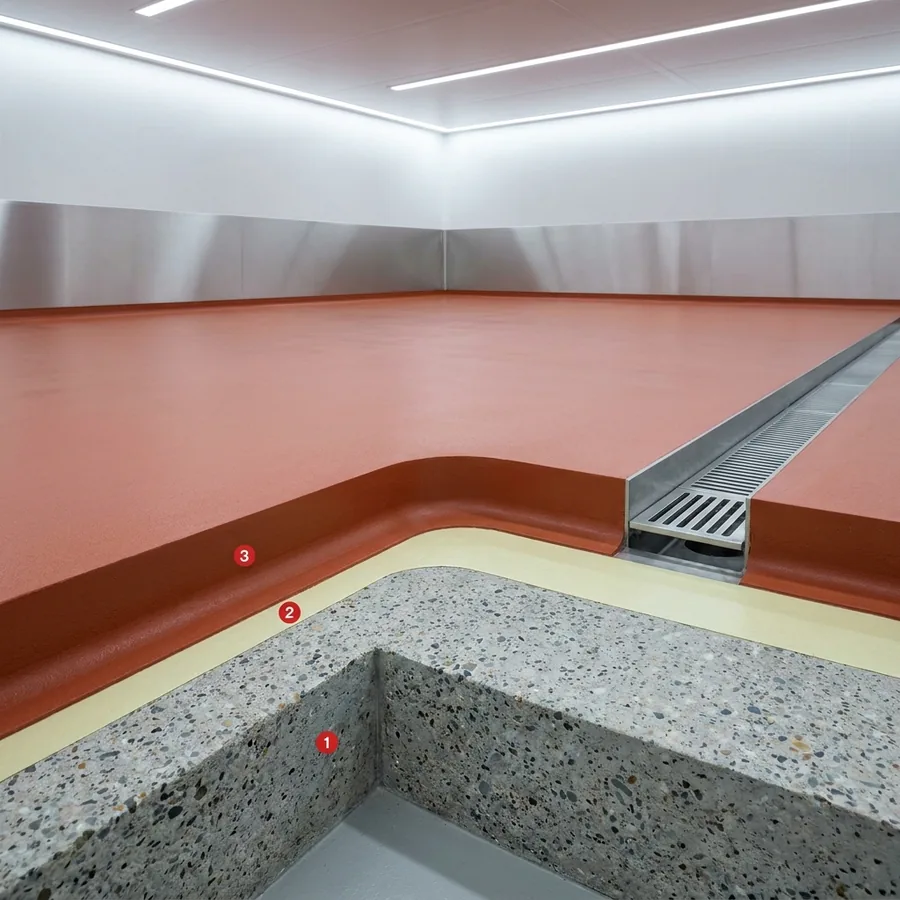
Raycrete SL for agri-food floors is a polyurethane-cement floor body. It is not Pavifloor and not a playground surface.
Raycrete SL (cementitious polyurethane mortar) is a three-liquid-component system plus a mineral filler. The 2026 Krypton Chemical catalogue lists it for the food industry, food-processing facilities, kitchens, and the pharmaceutical and chemical industry. The flooring catalogue cites a 1,400 m² refrigerated process room in France.
What Raycrete SL resists
Agri-food floors in the 2026 catalogue are specified against aggressive cleaning, contaminants, oils, greases, chemical attack and thermal shock. High-temperature washing and hot–cold cycling are why a polyurethane-cement mortar is used here instead of a flexible comfort body. Pavifloor (self-levelling 100% solids polyurethane) is a different indoor coating.
A kitchen floor is not a chemical bund: liquid containment uses Polyurea Rayston Fast or Impermax Cold Polyurea Supreme. The mix ratio of A, B, pigment and filler is given in the current TDS, as is consumption; then use the calculator.
Specifying a Raycrete SL agri-food floor
Describe the food traffic, wash-down and thermal shock, then specify Raycrete SL (cementitious polyurethane mortar) with Primer Epoxy Plus where the catalogue lists it. Once the data sheet has been checked, the calculator helps you size the area.
Details are on the Raycrete SL product entry and the agri-food flooring, food and beverage plants and chemical and pharmaceutical plants application pages. Data sheets are in documents, and the calculator helps you size the area.
External reference: CEN-CENELEC.
A cold store has very different requirements from a sports court.
Mix ratio and overcoat interval come from the current TDS rather than from estimates.
This article is general technical guidance from Krypton Chemical and does not replace the current technical data sheet (TDS), the safety data sheet (SDS) or the project specification. Pack sizes, mix ratio and consumption in kg/m² are given in the current TDS; with those figures, the calculator helps you estimate quantities for your area.