
Home / Knowledge / Marine vessels, ports and docks
Marine vessels, ports and docks
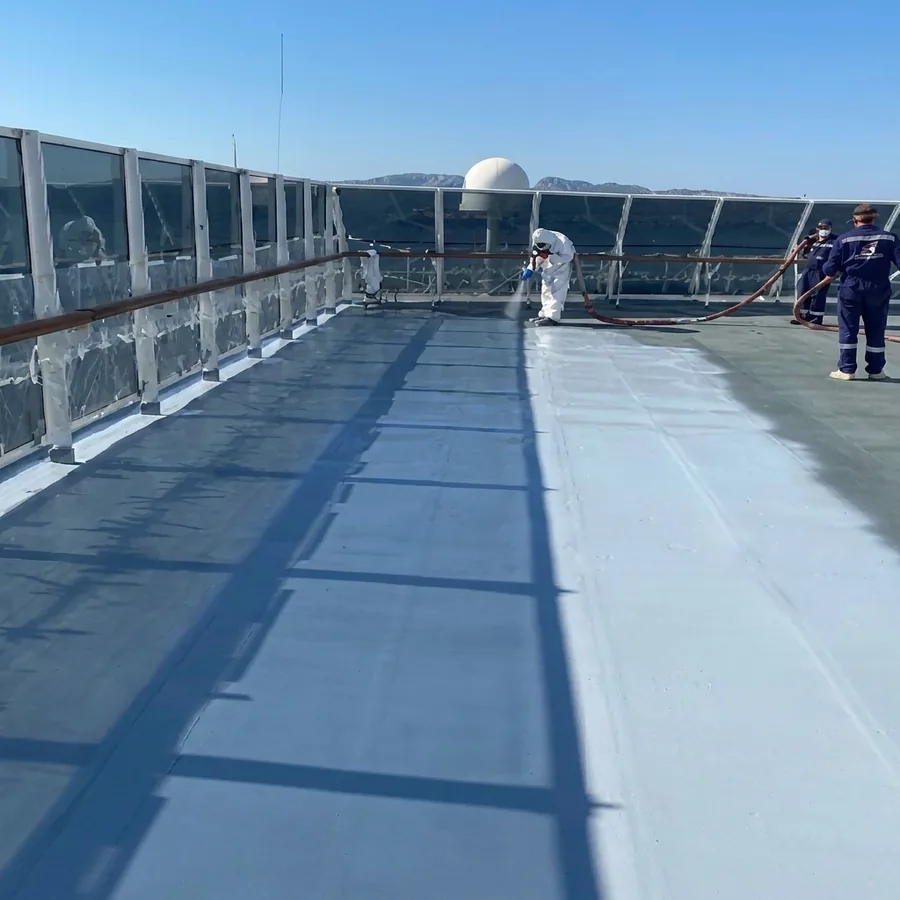
Marine vessels, ports and docks are covered by the Krypton ProLine range. The 2026 Krypton Chemical catalogue lists pontoons, catamarans, ferry access ramps and ship decks, and Krypton ProLine (industrial protective coatings for oil and gas, marine and ports) is designed to resist seawater, salt and sun. This is a very different exposure from a sports floor.
What ports and docks require
The industrial catalogue lists abrasion, corrosion and impact on decks and ramps, while interior naval spaces add scratching and impact. Krypton ProLine AB95P and AB85H are the abrasion-resistant products; chemical and corrosion protection is provided by CH55, CH80 and the PU primers. The UV-stable topcoat is also a named ProLine finish, not Colodur Eco from the flooring range.
Polyurea Rayston (pure polyurea) is a waterproofing membrane and is not automatically a marine deck coating. The 2026 catalogue does not cite a dry-dock reference project for this application.
Take consumption from the current TDS, then use the calculator. Primer, body and finish are each specified as named products.
Further information
More details are on the marine vessels and ports and ports and harbors application pages and the ProLine AB85H product entry, with data sheets in documents.
External reference: CEN-CENELEC.
A ferry ramp combines vehicle traffic with seawater exposure.
Mix ratio, overcoat interval and consumption always come from the current TDS, and the calculator then turns them into quantities for your area. The application page shows the full system build-up. A sound specification starts with the exposure, names the commercial product together with its chemical type, and refers to the current documents. A sample, a colour chip or a photograph cannot replace that wording.
This article is general technical guidance from Krypton Chemical and does not replace the current technical data sheet (TDS), the safety data sheet (SDS) or the project specification. Pack sizes, mix ratio and consumption in kg/m² are given in the current TDS; with those figures, the calculator helps you estimate quantities for your area.